Yield Curve Slope Signal
Yield curve slope signal: tracking recession risk and monetary stance via curve shape.
Gemini Summary
Signal Summary:
- Configuration statement (mandatory): Given the T10Y2Y spread at 0.51 and T10Y3M at 0.65, this setup aligns with Range-biased price paths and Normal volatility, where the dominant risk is a Regime shift toward expansion, not mean reversion. (1)
- The signal is currently in a Flat/Neutral regime, reflecting a transition away from restrictive policy towards economic normalization. (1)
- Conviction Band: Low; Interpretation Confidence: High Confidence; Internal Conflict Flag: No. Signal Stability Assessment: Improving; Threshold Proximity: Near; Revision Sensitivity: Moderate.
Methodology Applied:
- A Composite Z-score between -0.50 and 0.50 defines a Flat or Neutral curve, implying mid-cycle stability. (1)
- Persistent readings above 0.75 indicate a Steepening curve, signaling expansionary bias and economic acceleration. (1)
- Readings below -0.75 indicate an Inverted curve, signaling restrictive policy relative to growth. (1)
- Yield Curve Slope Signal: Latest observation 2026-03-31. (1)
Key Dynamics:
- The primary driver is the rising Z-score of the T10Y3M spread (0.69), which is approaching expansionary territory. (1)
- Momentum is currently stabilizing in positive territory after a long period of inversion throughout 2023. (1)
- Conditional Invalidation: The composite Z-score falls below -0.75 for two consecutive months. (1)
- Signal stability is high, with the 10Y2Y and 10Y3M components showing directional alignment. (1)
Scenario Balance:
- Base case dominant; risks balanced.
- Most plausible upside risk: Acceleration into an expansionary regime if the composite breaches 0.75.
- Most plausible downside risk: Re-inversion if short-term rates rise faster than growth expectations.
Time Horizon & Aggregation:
- Time Horizon: Cyclical (months) due to the multi-quarter lag between curve shifts and economic impact. (1)
- Aggregation Weight Hint: Medium; the signal is a primary macro lead but currently lacks a directional breakout.
Macro Relevance:
- This signal informs the macro dimension of growth expectations and policy restrictiveness. (1)
- The economic mechanism is the transmission of Federal Reserve policy rates into long-term funding costs and term premiums. (1)
- Cycle position: Mid-cycle transition (not determined for specific phase).
- Interacts typically with credit spreads and volatility to confirm financial stress levels. (1)
Regime Context:
- The current Flat/Neutral regime has persisted since August 2024 (approx. 20 months). (1)
- Direction of change: Strengthening towards an expansionary (Steepening) regime. (1)
Model Limitations:
- Lagging indicator properties (2-6 quarters) and potential distortion by QE/QT. (1)
- Subject to constant-maturity yield revisions. (1)
Data & References:
Yield Curve Slope Chart
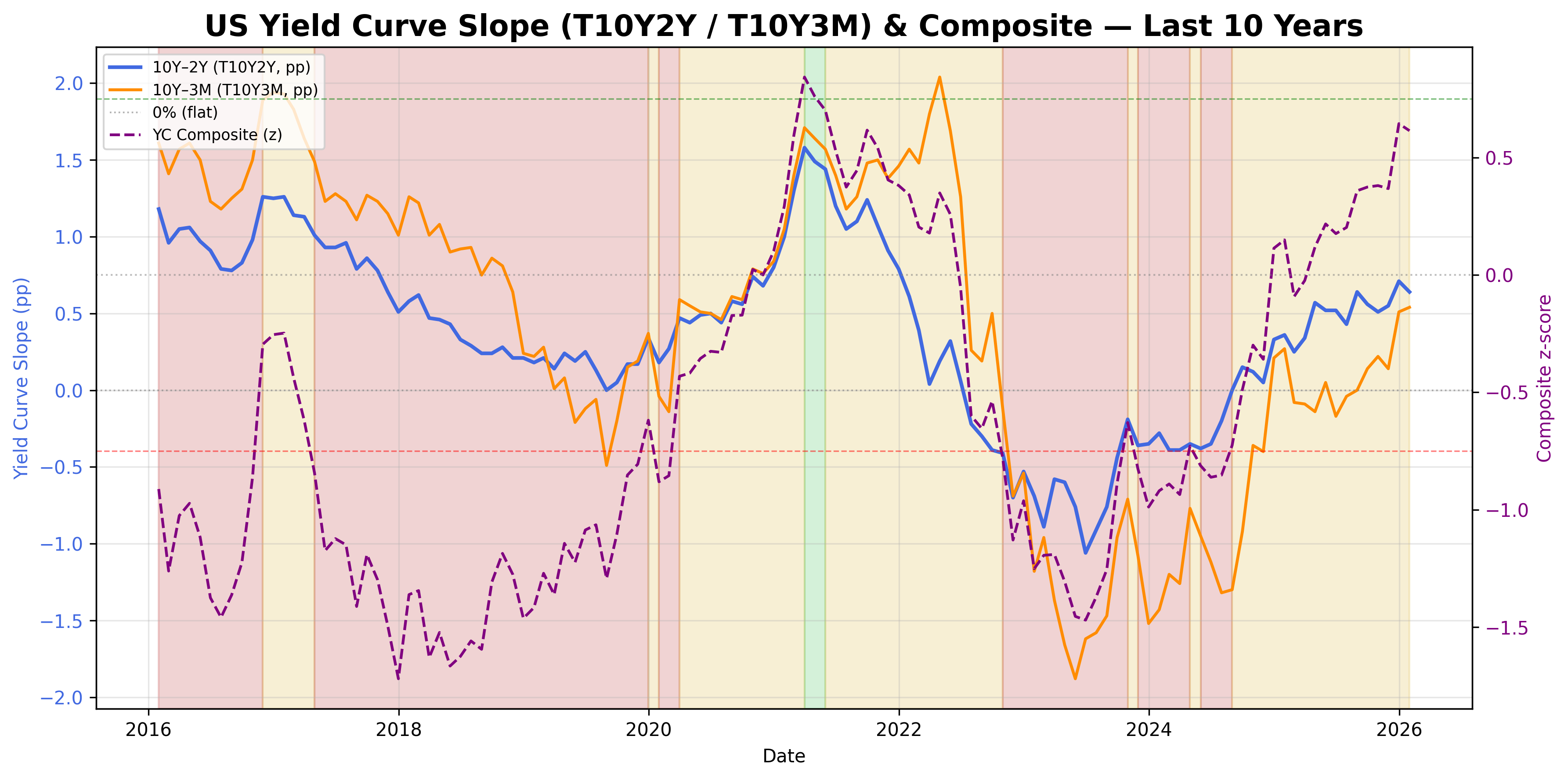
U.S. yield curve slope across 10Y-2Y and 10Y-3M indicators.
Yield Curve Slope Table▸
The information presented is for general informational purposes only and does not constitute financial or investment advice. It has been prepared without regard to individual objectives, financial situation, or needs. You should consider whether it is appropriate for your circumstances and seek independent advice where necessary.