Specs vs Hedgers Divergence: Reversal Risk
Specs vs hedgers divergence: macro reversal risk indicator.
Gemini Summary
Signal Summary:
- Configuration statement: Given a Macro_Divergence_Risk_z of -1.54 and a divergence_share of 21.2%, this setup aligns with Indeterminate price paths and Compressed volatility, where the dominant risk is Trend continuation, not Regime shift (1).
- The signal is currently in a "Low Divergence" regime, indicating unusually high alignment between speculative and commercial participants (1).
- Conviction Band: High; Interpretation Confidence: High Confidence; Internal Conflict Flag: No. Signal Stability Assessment: Stable; Threshold Proximity: Far; Revision Sensitivity: Unknown.
Methodology Applied:
- Robust Z-Score < -0.5 defines a "Low Divergence" regime, implying strong macro consensus (1).
- Positioning alignment (Macro_Divergence_Risk_z) determines the probability of trend persistence or exhaustion (1).
- Speculator and Commercial Hedger z-scores are used as primary drivers to assess internal market tension (1).
- Specs vs Hedgers Divergence: Reversal Risk (Latest observation: 2026-03-17) (1).
Key Dynamics:
- The primary driver is the low divergence_share (0.21), suggesting speculators and hedgers are broadly in agreement (1).
- Macro_Divergence_Risk_z has remained deep in negative territory (-1.54), signifying persistent consensus (1).
- Conditional Invalidation: An increase in Macro_Divergence_Risk_z above the -0.5 threshold would signal a move to a Neutral regime.
- Signal stability is high, with the "Low Divergence" regime persisting for over 15 weeks (1).
Scenario Balance:
- Base Case dominant: Current market trends persist due to high participant alignment.
- Upside risk: Sudden speculative inflow strengthens existing price momentum further.
- Downside risk: A sharp rise in divergence (z > 0.5) indicating emerging commercial hedging pressure.
Time Horizon & Aggregation:
- Time Horizon: Tactical (weeks) due to the frequency of CoT positioning reporting (1).
- Aggregation Weight Hint: High, as the depth of consensus provides a stable foundation for trend analysis.
Macro Relevance:
- Informs the "sentiment" and "positioning" dimension of macro aggregation.
- The economic mechanism is macro consensus, where commercial fundamentals and speculative narratives are highly aligned (1).
- Cycle position: Not determined.
- Interacts with volatility signals (VIX/MOVE) by providing a structural explanation for compressed volatility regimes (1).
Regime Context:
- The current "Low Divergence" regime is persistent, having been maintained since at least December 2025.
- The direction of change is stabilising, as the z-score remains deeply negative and far from the regime threshold (1).
Model Limitations:
- Requires significant z-score magnitudes on both sides to trigger specific regime shifts (1).
- Can be lagging due to the reporting frequency of underlying CoT data (1).
Data & References:
- Specs vs Hedgers Divergence: Reversal Risk (Observation: 2026-03-17) (1).
- Influential data: Macro_Divergence_Risk_z (-1.545) and Divergence_share (0.212).
- Additional public datasets: VIX and MOVE indices would provide external validation of current compressed volatility.
Specs vs Hedgers Divergence Chart
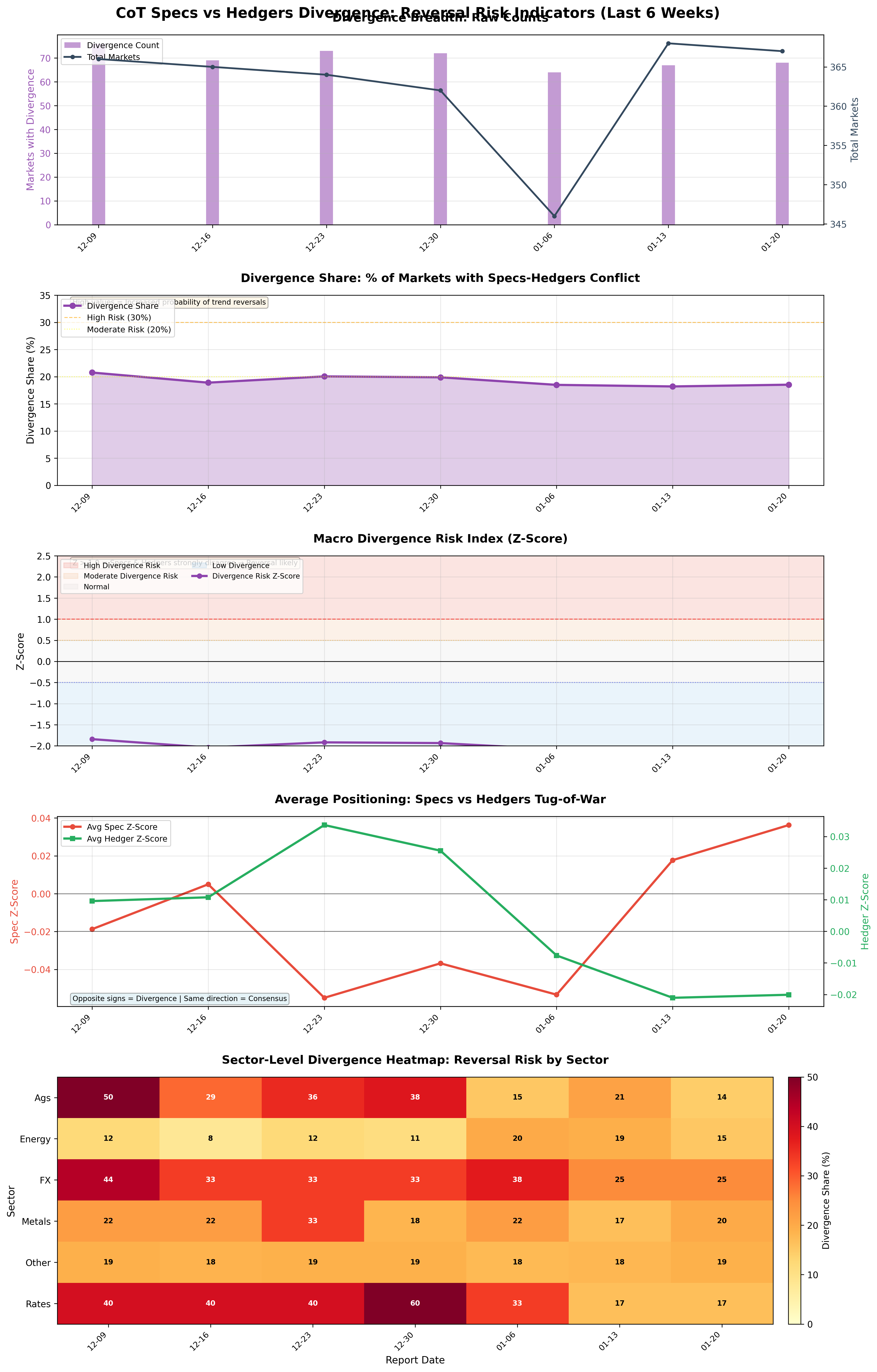
Specs vs hedgers divergence and reversal risk by market breadth.
Specs vs Hedgers Divergence Table▸
The information presented is for general informational purposes only and does not constitute financial or investment advice. It has been prepared without regard to individual objectives, financial situation, or needs. You should consider whether it is appropriate for your circumstances and seek independent advice where necessary.