Private Credit Impulse Signal
Private credit impulse: momentum in bank and consumer credit growth.
Gemini Summary
Signal Summary:
- Configuration statement (mandatory): Given the March 2026 Private_Credit_Impulse of 0.83 and a TOTBKCR z-score of 0.83, this setup aligns with Upward-biased price paths and Normal volatility, where the dominant risk is Trend continuation, not mean reversion (1).
- The signal has entered the Accelerating regime, having met the two-period confirmation rule following the February 2026 expansion (1).
- Conviction Band: Medium; Interpretation Confidence: Mixed Signals; Internal Conflict Flag: Yes. Signal Stability Assessment: Improving; Threshold Proximity: Near; Revision Sensitivity: High.
Methodology Applied:
- Composite values > 0.75 confirmed for two periods indicate accelerating credit growth and early/mid-cycle expansion (1).
- Regime transitions within [-0.75, 0.75] are classified as Stable, representing trend-following momentum (1).
- Commercial Bank Credit (TOTBKCR) and Business Loans (BUSLOANS) serve as primary drivers of the aggregate impulse (1).
- Latest observation date: 2026-03-31 (1).
Key Dynamics:
- The primary driver is the expansion in Total Bank Credit (z-score 0.83), outweighing previous stability in consumer segments (1).
- Momentum has inflected higher, moving from a stable -0.13 in late 2024 to the current accelerating state (1).
- Internal Conflict: The latest March print lacks BUSLOANS and TOTALSL sub-components, forcing reliance on bank credit data alone (1).
- Conditional Invalidation: The composite falling below 0.75 for two consecutive periods (1).
- Signal stability is improving as the trend shifts from a long-term stable baseline into cyclical expansion (1).
Scenario Balance:
- Base Case dominant: Accelerating credit creation sustains risk-on sentiment and expansionary financing conditions.
- Upside secondary: Business loan demand (BUSLOANS) rebounds to February z-score levels (1.34) once data is released.
- Downside residual: High revision sensitivity leads to a retroactive drop in bank credit below the 0.75 threshold.
Time Horizon & Aggregation:
- Time Horizon: Cyclical (months) due to the two-period confirmation requirement for regime shifts (1).
- Aggregation Weight Hint: Medium; current missing sub-components for the latest month reduce immediate signal reliability.
Macro Relevance:
- This signal informs liquidity and demand dimensions by measuring the velocity of private-sector credit creation (1).
- Economic mechanism: Accelerating credit implies easing financing conditions, supporting capital expenditure and aggregate cyclical demand (1).
- Cycle position: Early/mid-cycle expansion (1).
- Interaction: Typically leads GDP growth and serves as a confirmation signal for Industrial Production and Capex Intent.
Regime Context:
- Newly entered Accelerating regime following a persistent Stable period throughout 2024 and 2025 (1).
- Direction of change: Strengthening; the impulse moved from -0.70 in Dec 2024 to 0.83 in Mar 2026 (1).
Model Limitations:
- Frequent weekly revisions to H.8 bank data can cause retroactive regime flips (1).
- Nominal growth figures may distort the impulse during periods of high inflationary pressure (1).
Data & References:
Private Credit Impulse Chart
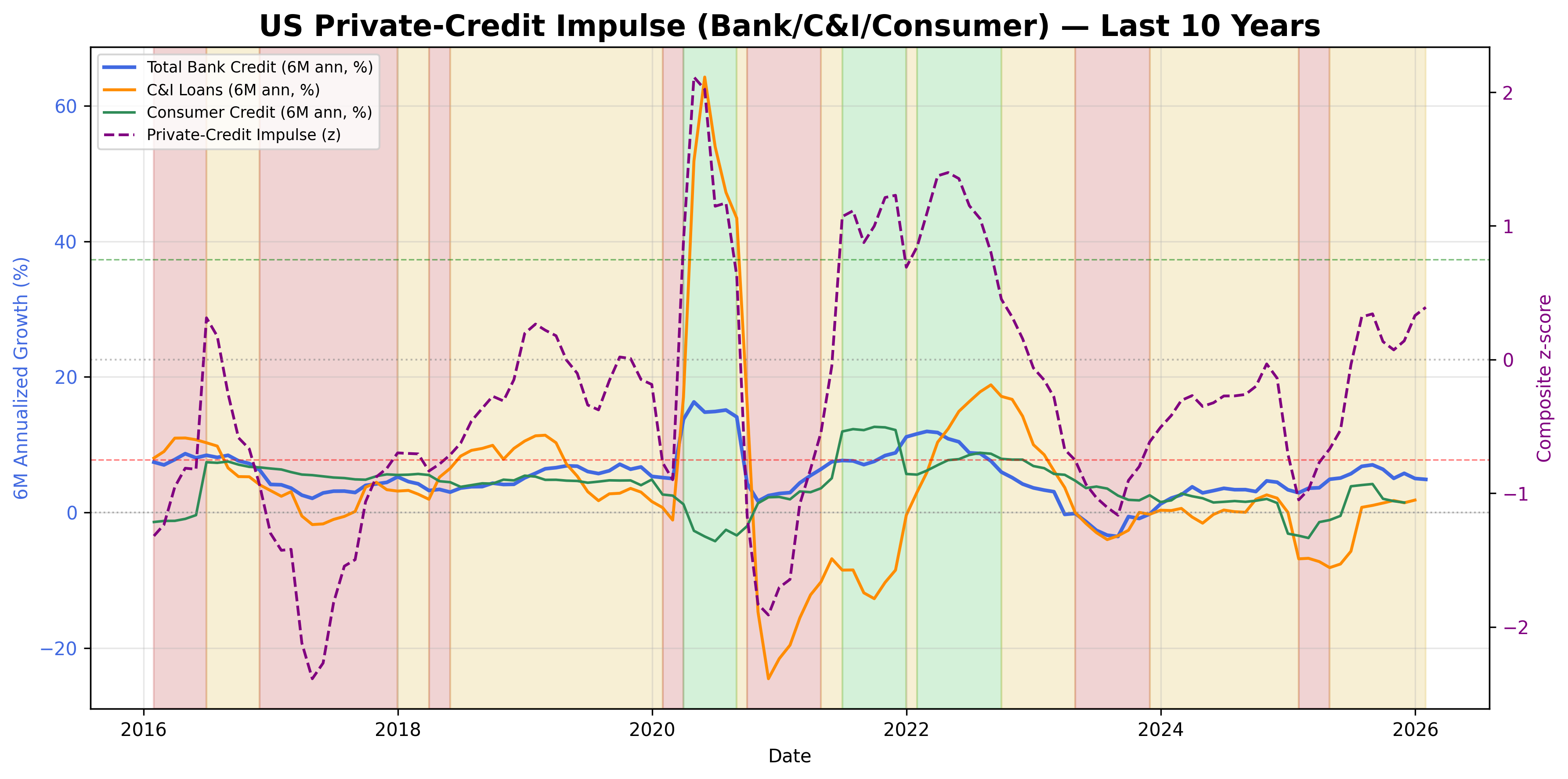
Momentum in U.S. bank credit, business lending, and consumer loans.
Private Credit Impulse Table▸
The information presented is for general informational purposes only and does not constitute financial or investment advice. It has been prepared without regard to individual objectives, financial situation, or needs. You should consider whether it is appropriate for your circumstances and seek independent advice where necessary.