Credit Spreads Signal
Corporate credit spreads as a funding-stress and risk appetite indicator.
Gemini Summary
Signal Summary:
- Configuration statement: Given HY_OAS at 3.94% and IG_OAS at 1.09%, this setup aligns with Downward-biased price paths and Elevated volatility, where the dominant risk is Long liquidation, not Mean reversion (1).
- The signal has transitioned into a Tightening regime driven by acute momentum in high-yield markets (1).
- Conviction Band: Low; Interpretation Confidence: Low Confidence; Internal Conflict Flag: Yes. Signal Stability Assessment: Deteriorating; Threshold Proximity: Near; Revision Sensitivity: Moderate.
Methodology Applied:
- HY levels rising > 50 bps in 3 months triggers a Risk-off/Tightening classification regardless of absolute level (1).
- Levels for HY between 3.5% and 5.0% define a Neutral/Normal regime when momentum is stable (1).
- Prioritization is given to High Yield (HY) components for cyclical sensitivity over Investment Grade (IG) (1).
- Credit Spreads Signal: Latest observation dated 2025-04-30 (1).
Key Dynamics:
- The primary driver is the 107 bps expansion in HY_OAS over the last three months, breaching the 50 bps momentum threshold (1).
- IG_OAS has stabilised at lower levels (1.09) relative to HY, creating an internal tension between credit tiers (1).
- Internal Conflict Flag is triggered by the absence of CSC z-score components in the current dataset (1).
- Conditional Invalidation: HY_OAS falling below 3.5% or momentum reversal (1).
- Signal stability is deteriorating, with HY_OAS widening for three consecutive periods from a 2.68 low (1).
Scenario Balance:
- Dominant base case: Persistent tightening as momentum suggests a transition toward higher risk premia (1).
- Upside risk: Spreads stabilise within the 3.5%-5.0% "Normal" range if macro conditions ease (1).
- Downside risk: HY_OAS exceeds 6.5%, triggering a "Stressed" systemic shock regime (1).
Time Horizon & Aggregation:
- Time Horizon: Cyclical (months); momentum rules are designed to lead equity drawdowns and capex shifts (1).
- Aggregation Weight Hint: Low; although momentum is strong, the absence of composite z-scores limits statistical conviction (1).
Macro Relevance:
- The signal informs corporate funding stress and market-wide risk appetite (1).
- Economic mechanism: Rising spreads imply increased default risk and transition risk, leading to margin pressure (1).
- Cycle position: Not determined from provided methodology mapping.
- Interacts typically with VIX and liquidity reserves to confirm systemic vs credit-specific stress (1).
Regime Context:
- The signal has newly entered a Tightening regime following a period of "EASY" conditions in early 2025 (1).
- Direction of change: Strengthening towards the Stressed threshold (1).
Model Limitations:
- Bid-ask spread inflation during liquidity shocks can cause false regime flips (1).
- 1-2 day reporting lags and vendor revisions may impact real-time tactical accuracy (1).
Data & References:
Credit Spreads Chart
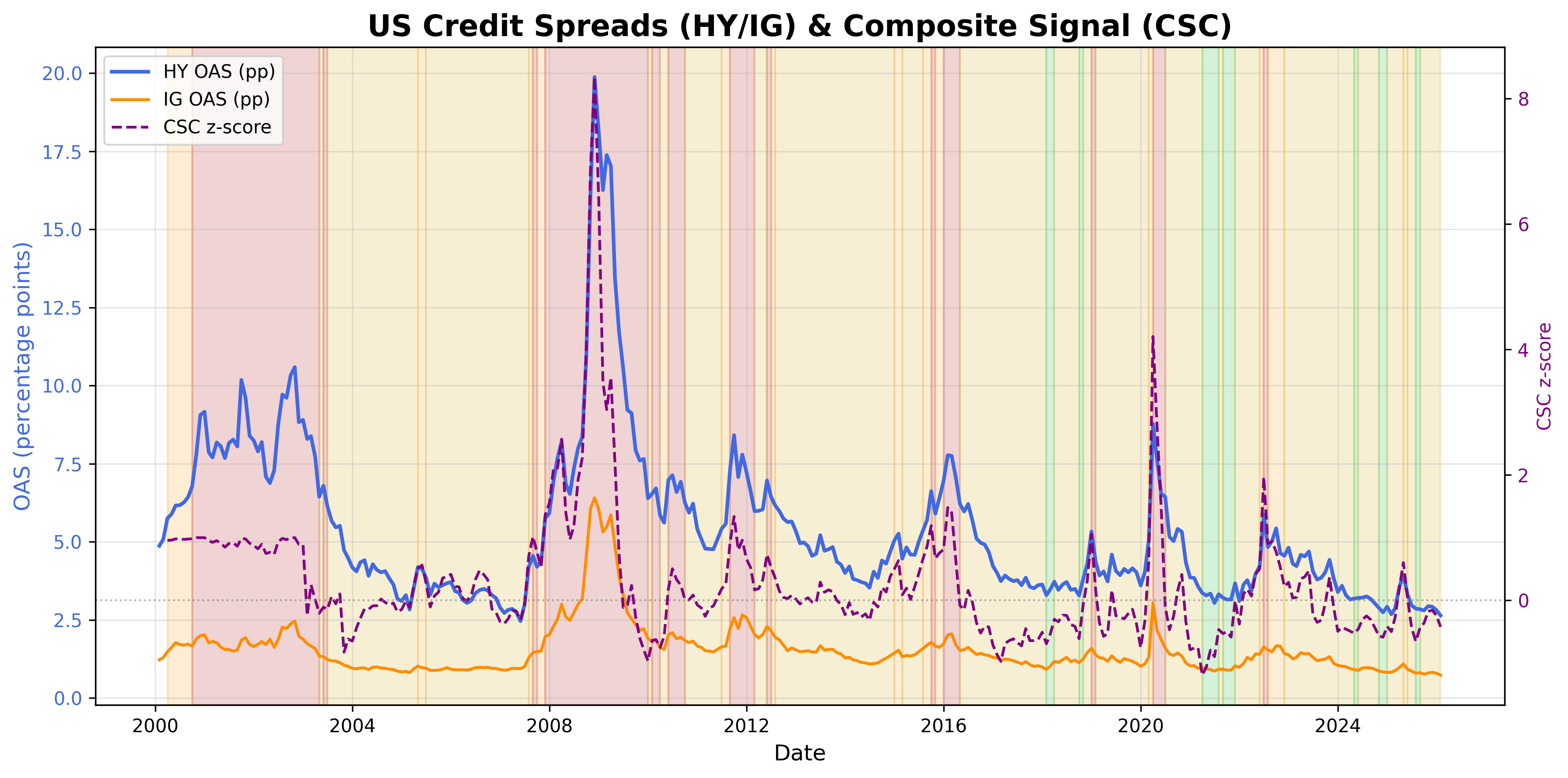
U.S. corporate credit spread dynamics.
Credit Spreads Table▸
The information on this website is provided for general informational and educational purposes only and does not constitute financial, investment, legal, or tax advice. It does not take into account any individual objectives, financial situation, or needs.
All views expressed are personal, based on publicly available information, and do not represent the views of any employer or reflect any proprietary or internal analysis. This information should not be relied upon for making investment decisions.
No representation or warranty is made as to the accuracy, completeness, or timeliness of the information, and no liability is accepted for any loss arising directly or indirectly from its use.
All views expressed are personal, based on publicly available information, and do not represent the views of any employer or reflect any proprietary or internal analysis. This information should not be relied upon for making investment decisions.
No representation or warranty is made as to the accuracy, completeness, or timeliness of the information, and no liability is accepted for any loss arising directly or indirectly from its use.