Financial Stress Index Signal
Market-wide financial stress and systemic risk conditions.
Gemini Summary
Signal Summary:
- Configuration statement: Given the latest STLFSI4 value of -0.299 and a Stress_z of 1.214, this setup aligns with Downward-biased price paths and Elevated volatility, where the dominant risk is Regime shift, not Mean reversion.
- The signal is currently classified as Bearish, indicating a transition toward higher systemic financial stress (1).
- Conviction Band: Medium; Interpretation Confidence: High Confidence; Internal Conflict Flag: No. Signal Stability Assessment: Deteriorating; Threshold Proximity: Near; Revision Sensitivity: Unknown.
Methodology Applied:
- A Bearish regime is triggered when STLFSI4 > 0 or the Robust Z-score > 0.5, implying tightening conditions (1).
- A Bullish regime requires STLFSI4 < 0 and a Robust Z-score < -0.5 (1).
- Neutral regimes are identified when neither Bearish nor Bullish criteria are met (1).
- Financial Stress Index (STLFSI4) data used through latest observation date 2026-03-13 (1).
Key Dynamics:
- The primary driver is the Stress_z score reaching 1.214, significantly exceeding the 0.5 Bearish threshold (1).
- Momentum is accelerating; the Z-score has risen from -0.146 on 2026-02-06 to 1.214 in five weeks (1).
- Internal tensions are absent as both level and momentum components support the Bearish classification.
- Conditional Invalidation: The Z-score falling below 0.5.
- Signal stability is deteriorating as the index trends toward the absolute zero threshold for stress.
Scenario Balance:
- Base case dominant: Sustained Bearish regime as Z-scores remain elevated.
- Most plausible upside risk: Rapid mean reversion to Neutral triggered by a compression in credit risk premiums.
- Most plausible downside risk: STLFSI4 crossing above 0, signaling acute systemic funding stress.
Time Horizon & Aggregation:
- Time Horizon: Tactical (weeks); the methodology prioritizes Z-score surges for tactical risk control (1).
- Aggregation Weight Hint: Medium; the persistent Bearish classification since late February suggests a meaningful macro headwind.
Macro Relevance:
- Informs the financial stress and risk sentiment dimension of the macro landscape (1).
- Economic mechanism: Implies tightening financial system liquidity and rising market risk aversion (1).
- Cycle position: Not determined.
- Typically interacts with credit and liquidity signals to confirm or conflict with growth-driven market dislocations (1).
Regime Context:
- The current Bearish regime was newly entered on 2026-02-27 and has persisted for three weeks (1).
- Direction of change: Strengthening Bearish bias as stress levels intensify.
Model Limitations:
- Susceptible to weekly reporting lags and sensitivity to threshold whipsaws near zero (1).
- Data staleness in sub-components like the TED spread may impact real-time accuracy (1).
Data & References:
- STLFSI4 and Stress_z provided through 2026-03-13 (1).
- Dominant datapoint: Stress_z (1.213989).
- Public datasets: VIX and High Yield OAS to improve component-level depth.
Financial Stress Index Chart
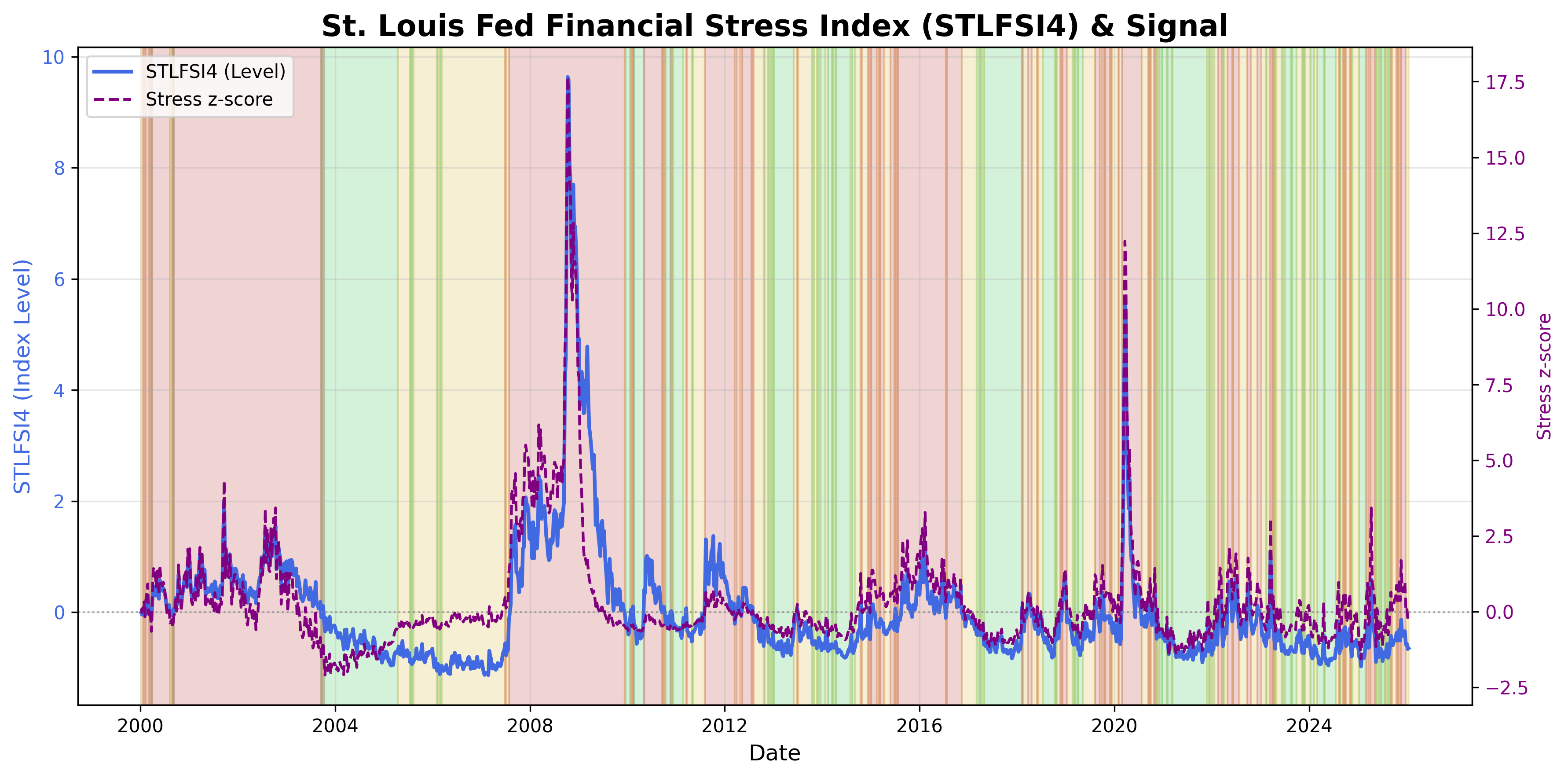
Composite financial stress conditions across markets.
Financial Stress Index Table▸
The information presented is for general informational purposes only and does not constitute financial or investment advice. It has been prepared without regard to individual objectives, financial situation, or needs. You should consider whether it is appropriate for your circumstances and seek independent advice where necessary.