Wage Growth and Inflation Signal
Wage growth and inflation composite: assessing labour-cost pressures and price dynamics.
Gemini Summary
Signal Summary:
- Configuration statement (mandatory): Given a Wage_Pressure_z of -0.53 and Labor_Tightness_z of -0.17 (1), this setup aligns with Range-biased price paths and Normal volatility, where the dominant risk is Mean reversion, not Regime shift.
- The signal is currently in a NEUTRAL regime, indicating wage growth aligned with historical norms (1).
- Conviction Band: Low; Interpretation Confidence: Low Confidence; Internal Conflict Flag: No. Signal Stability Assessment: Stable; Threshold Proximity: Moderate; Revision Sensitivity: Unknown.
Methodology Applied:
- A z-score between -1.0 and +1.0 designates a NEUTRAL regime, implying a stable inflation outlook (1).
- The Inflation Composite blends Wage Pressure and Labor Market Tightness (LMT) to predict core inflation persistence (1).
- Weights are applied to Employment Cost Index (ECI) for private and civilian workers to compute pressure (1).
- Wage Growth and Inflation Signal: observation date not provided.
Key Dynamics:
- The primary driver is the convergence of Private and Civilian Wage YoY growth at 3.3% (1).
- Stabilisation is evident as the Inflation Composite z-score has remained in the NEUTRAL band for fifteen consecutive observations (1).
- Internal coherence is high as both wage and labor tightness metrics support a non-inflationary expansion.
- Conditional Invalidation: An Inflation Composite z-score exceeding +1.0 (HOT regime) (1).
- The signal exhibits high persistence, having maintained the NEUTRAL classification throughout the provided history.
Scenario Balance:
- Base case dominant: Continued range-bound inflation as wage growth tracks the 24-month baseline (1).
- Upside risk: A sudden spike in Labor_Tightness_z triggering a "HOT" wage-push inflation regime (3).
- Downside risk: Rising labor market slack leading to a "COOL" disinflationary transition (1).
Time Horizon & Aggregation:
- Time Horizon: Cyclical (months); ECI inputs are quarterly and reflect medium-term cost structures (1).
- Aggregation Weight Hint: Low; data timeliness cannot be assessed from provided content.
Macro Relevance:
- Informs the "pricing" macro dimension by measuring the intensity of wage-push inflation (1).
- Economic mechanism: Inflationary pressure originating from labor costs and supply-demand imbalances (1).
- Cycle position: Not determined.
- Typically confirms trends in Policy-Relevant Inflation (PCE) (2) and labor demand signals.
Regime Context:
- Persistent NEUTRAL regime; no recent transitions observed in the Inflation Composite.
- Direction of change: Stabilising within the neutral corridor.
Model Limitations:
- ECI data is quarterly and lagged, requiring interpolation between releases (1).
- JOLTS-based metrics (used for tightness) are subject to significant survey noise (1).
Data & References:
Wage Growth and Inflation Composite Chart
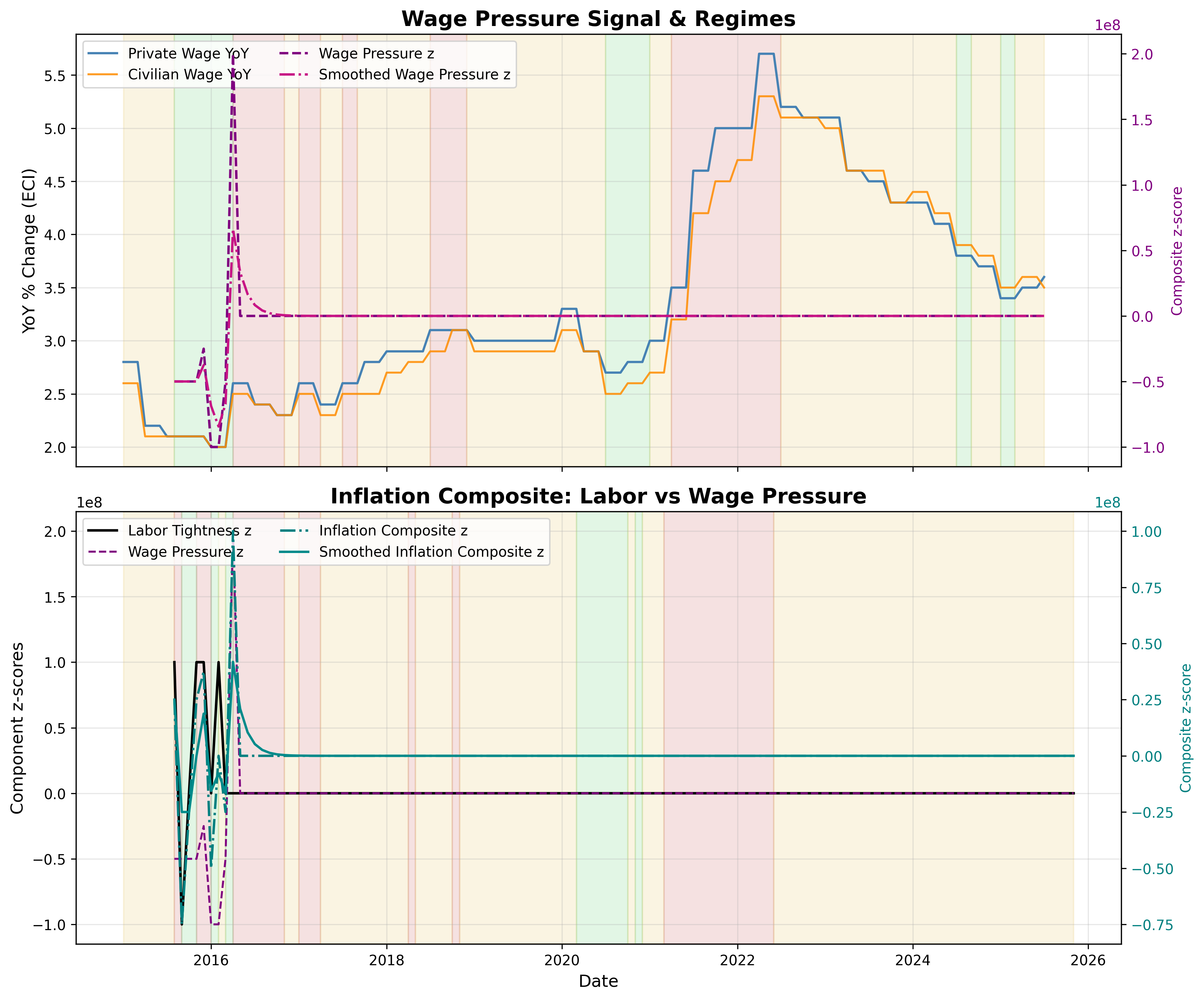
Composite of wage growth and inflation indicators.
Wage Growth and Inflation Composite Table▸
The information presented is for general informational purposes only and does not constitute financial or investment advice. It has been prepared without regard to individual objectives, financial situation, or needs. You should consider whether it is appropriate for your circumstances and seek independent advice where necessary.