Job Flows Signal
Job flows signal: tracking hires, separations and net flows in the labour market.
Gemini Summary
Signal Summary:
- Configuration statement: Given negative Net Job Creation of -321.0 and a Composite z-score of -0.6536, this setup aligns with Transition-biased price paths and Normal volatility, where the dominant risk is Regime shift, not Short covering.
- The signal currently resides in a NEUTRAL regime, though it has deteriorated significantly from its 2024 peak toward the "COOL" threshold (1).
- Conviction Band: Medium; Interpretation Confidence: High Confidence; Internal Conflict Flag: No. Signal Stability Assessment: Deteriorating; Threshold Proximity: Near; Revision Sensitivity: Moderate.
Methodology Applied:
- Regime classification uses an unsmoothed composite z-score where HOT > +0.75 and COOL < -0.75 (1).
- Weights are assigned to Gross Job Gains (0.40), Net Job Creation (0.40), and negated Gross Job Losses (0.20) (1).
- The signal uses quarterly BLS Business Dynamics Statistics (BDS) to capture firm-level hiring dynamism (1).
- Latest observation date: 2025-06-30 (1).
Key Dynamics:
- The dominant driver is the move into negative Net Job Creation (-321.0), the lowest reading in the provided series (1).
- Momentum is negative, with the Composite z-score falling from -0.158 in Q4 2024 to -0.653 in Q2 2025 (1).
- Labor Dynamism (4Q MA) has reached a cycle low of 63.25, indicating reduced structural churn (1).
- Conditional Invalidation: A reversal in Net Job Creation or a Composite z-score crossing above +0.75 (1).
- Deteriorating persistence is evident as the signal has trended downward for three consecutive quarters (1).
Scenario Balance:
- Base case dominant: Continued NEUTRAL state with a high probability of entering the COOL regime if Net Job Creation remains negative.
- Upside risk: Stabilization of Gross Job Gains above 7,700, potentially returning the signal to a mid-Neutral level.
- Downside risk: A further decline in the Composite z-score below -0.75, confirming a "COOL" regime shift and rising slowdown risk.
Time Horizon & Aggregation:
- Time Horizon: Cyclical (months); quarterly data frequency captures medium-term labor market structural shifts.
- Aggregation Weight Hint: Medium; serves as a critical leading indicator for the broader labor cycle when combined with high-frequency payrolls.
Macro Relevance:
- Informs the US Labour Market dimension by measuring firm-level hiring and firing dynamism (1).
- Economic mechanism: Waning churn and negative net creation imply a loss of firm-level resilience and emerging slack (1).
- Cycle position: Not determined, though proximity to COOL suggests late-expansion vulnerability (1).
- Typical interaction: High synergy with payroll breadth and unemployment duration signals (1).
Regime Context:
- The NEUTRAL regime has persisted for seven quarters but is currently weakening toward a transition (1).
- Direction of change: Weakening/Deteriorating.
Model Limitations:
- Uses quarterly frequency which may lag monthly payroll inflections (1).
- Dependent on BLS BDS revisions which can be substantial (1).
Data & References:
Job Flows Signal Chart
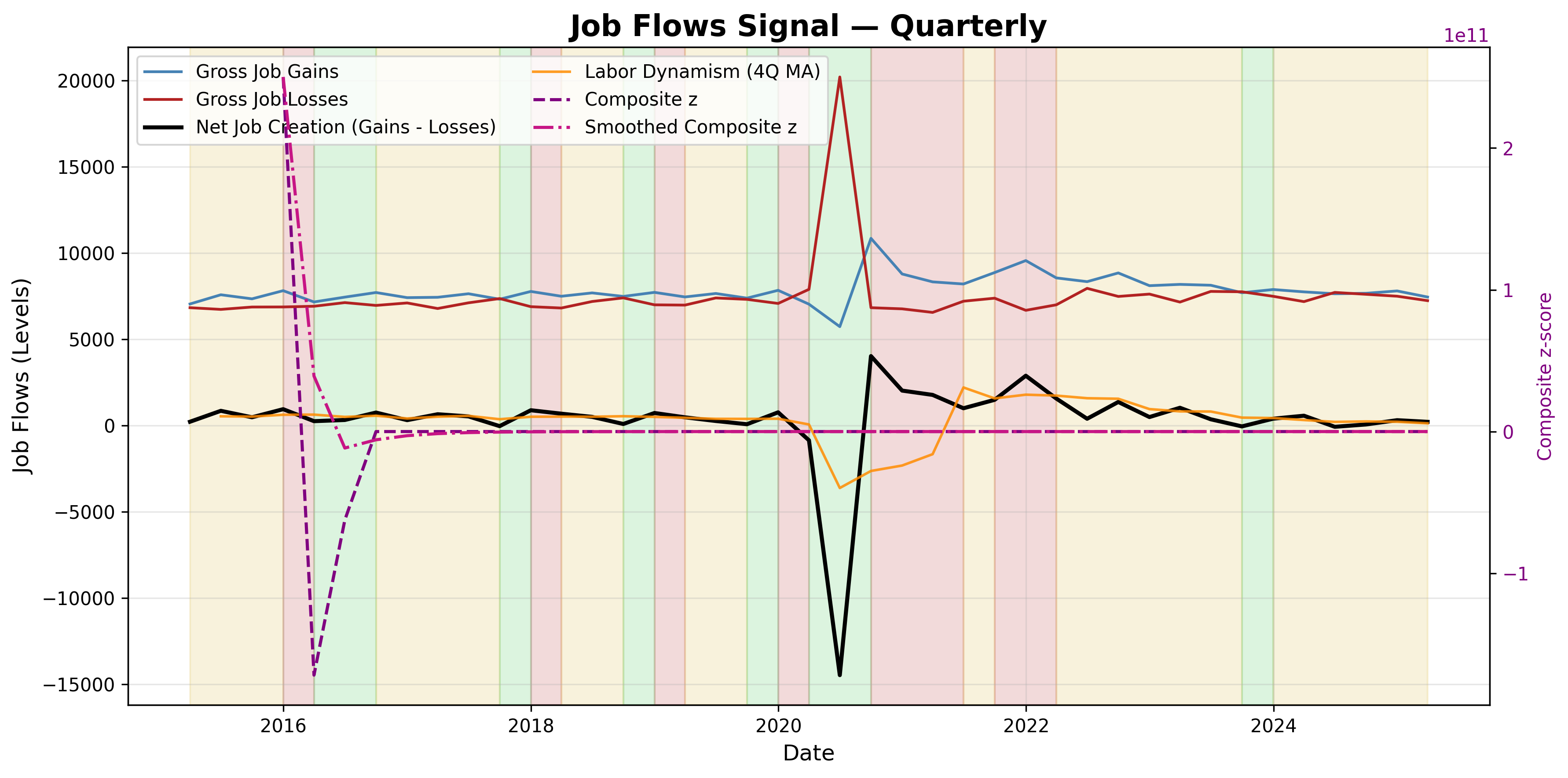
Job flows: hires, separations and net flows across the labour market.
Job Flows Signal Table▸
The information presented is for general informational purposes only and does not constitute financial or investment advice. It has been prepared without regard to individual objectives, financial situation, or needs. You should consider whether it is appropriate for your circumstances and seek independent advice where necessary.