Market Volatility (VIX) Signal
VIX market volatility signal: tracking investor fear and uncertainty.
Gemini Summary
Signal Summary:
- Configuration statement: Given a VIX level of 26.78 and an MVS_z of 2.12, this setup aligns with Downward-biased price paths and Elevated volatility, where the dominant risk is Long liquidation, not Mean reversion. (1)
- The signal is currently in a persistent STRESSED regime. (1)
- Conviction Band: High; Interpretation Confidence: High Confidence; Internal Conflict Flag: No. Signal Stability Assessment: Stable; Threshold Proximity: Near; Revision Sensitivity: Low.
Methodology Applied:
- STRESSED conditions occur when VIX ≥ 30 or MVS z-score ≥ 1.0, implying active liquidation. (1)
- CRISIS regime requires an MVS z-score ≥ 2.0 sustained for five consecutive days. (1)
- Rising values signal a transition toward risk-off sentiment and market contraction. (1)
- Market Volatility (VIX) Signal: Latest observation March 20, 2026. (1)
Key Dynamics:
- Main driver is the MVS_z (2.12), which identifies high market fear despite VIX being below 30. (1)
- Volatility shows persistence, having remained in the STRESSED regime for 14 consecutive trading sessions. (1)
- The signal is stabilising at elevated levels after peaking at 3.15 in early March. (1)
- Conditional Invalidation: MVS z-score falls below 1.0. (1)
Scenario Balance:
- Base case dominant: Persistent STRESSED regime as hedging demand remains elevated.
- Upside risk: Softening to NORMAL regime triggered by VIX falling below 20.
- Downside risk: Transition to CRISIS if MVS_z > 2.0 sustains for five days.
Time Horizon & Aggregation:
- Time Horizon: Tactical (weeks) reflecting short-term equity market uncertainty and hedging. (1)
- Aggregation Weight Hint: High as a core thermometer for risk-on/off positioning. (1)
Macro Relevance:
- Informs equity market risk sentiment and forward-looking tail-risk expectations. (1)
- Implied economic mechanism: Tightening risk appetite as the cost of downside protection becomes expensive. (1)
- Cycle position: Not determined by this methodology.
- Interacts with Credit Spreads; widening spreads would confirm the risk-off signal. (1)
Regime Context:
- Persistent STRESSED regime since March 2, 2026. (1)
- Direction of change: Stabilising at high levels. (1)
Model Limitations:
- Month-end snapshots may miss intramonth bursts; absolute VIX levels can undergo structural shifts. (1)
Data & References:
VIX Volatility Chart
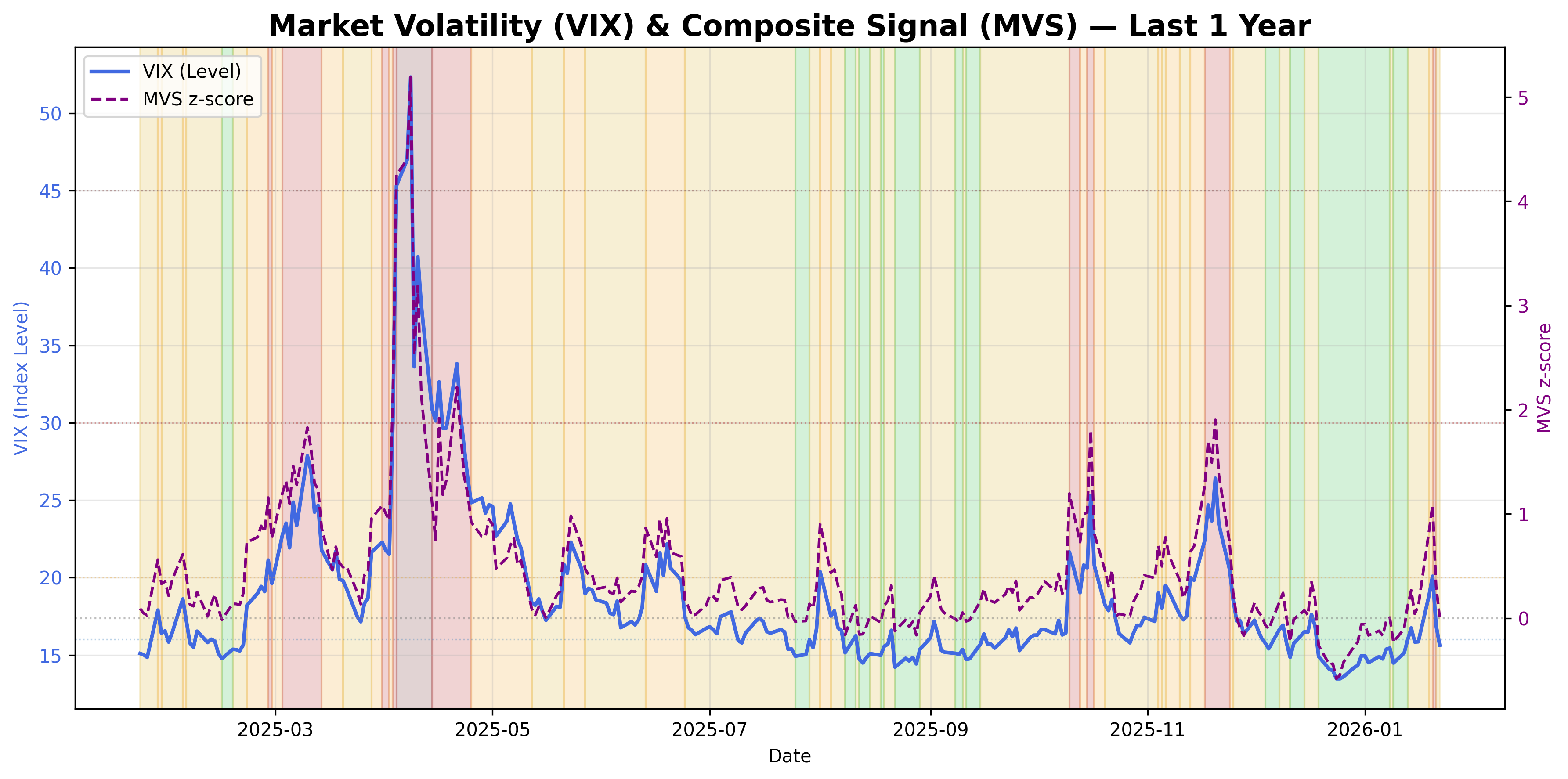
VIX index: market volatility and investor sentiment.
VIX Volatility Table▸
The information presented is for general informational purposes only and does not constitute financial or investment advice. It has been prepared without regard to individual objectives, financial situation, or needs. You should consider whether it is appropriate for your circumstances and seek independent advice where necessary.