Metals Comparative Signal
Regime-aware, multi-factor cross-metal signal with rolling relative value, z-scores, momentum, and macro USD adjustment.
Gemini Summary
Signal Summary:
- Configuration statement: Given an Aluminium Z-score of 3.10 and a Copper Z-score of 2.54, this setup aligns with Downward-biased price paths and Elevated volatility, where the dominant risk is Mean reversion, not Trend continuation. (1)
- The signal currently identifies a "Moderate Outflow Bias" within a "high_vol_dislocation" regime, driven by extreme overvaluation in industrial metals relative to historical norms. (1)
- Conviction Band: High; Interpretation Confidence: High Confidence; Internal Conflict Flag: No. Signal Stability Assessment: Deteriorating; Threshold Proximity: Near; Revision Sensitivity: Low. (1)
Methodology Applied:
- Standardisation Layer: Z-scores exceeding 2.0 trigger "Tactical Trim" or "Exhaustion Risk" status. (1)
- Relative Value Layer: Signals an "Overvalued" status when rolling percentiles for cross-metal ratios exceed 95.0. (1)
- Regime Weighting: The "high_vol_dislocation" profile assigns higher priority (0.4) to relative value diagnostics. (1)
- Metals Comparative Signal data latest observation: 2026-05-26. (1)
Key Dynamics:
- Extreme Z-scores in Aluminium (3.10) and Copper (2.54) indicate price levels are statistically stretched, triggering exhaustion flags. (1)
- Silver displays significant relative overvaluation against Gold (97.4th percentile) and Platinum (98.4th percentile). (1)
- Negative 3-month momentum (-0.159) suggests the recent price peak is fading into a broader outflow phase. (1)
- Conditional Invalidation: A reversal of the Silver vs. Gold overvaluation percentile below 95.0 or a shift to USD weakness. (1)
- Signal stability is deteriorating as prices retreat from May 13 peaks into a more volatile dislocation regime. (1)
Scenario Balance:
- Base case dominant: Continued mean reversion as industrial metal "exhaustion" leads to broader complex liquidation. (1)
- Upside risk: Supply-side shock in Copper or Aluminium triggers a "short squeeze" despite overvalued diagnostics. (1)
- Downside risk: Accelerated liquidity withdrawal (outflow bias) leads to a high-volatility price collapse. (1)
Time Horizon & Aggregation:
- Tactical (weeks): Based on 3-month momentum windows and standardisation "trim" signals. (1)
- Aggregation Weight Hint: High; strong internal consistency between relative value, momentum, and statistical z-scores. (1)
Macro Relevance:
- Informs industrial demand and pricing pressure dimensions. (1)
- The signal implies a liquidity-driven exhaustion mechanism where high-beta metals (Silver, Copper) are losing support. (1)
- Cycle position: Not determined. (1)
- Typically acts as a lead indicator for broader commodity sector cooling when relative value dispersion peaks. (1)
Regime Context:
- Persistent: The "high_vol_dislocation" regime has remained active through the recent May price volatility. (1)
- Direction of change: Strengthening outflow bias as prices stabilise below mid-month highs. (1)
Model Limitations:
- Regime detection is subject to hysteresis effects which may lag sudden price reversals. (1)
- Z-score percentiles assume a normal distribution which may be violated during extreme dislocations. (1)
Data & References:
Metals Comparative Dashboard v1.2 (Regime-Adaptive)
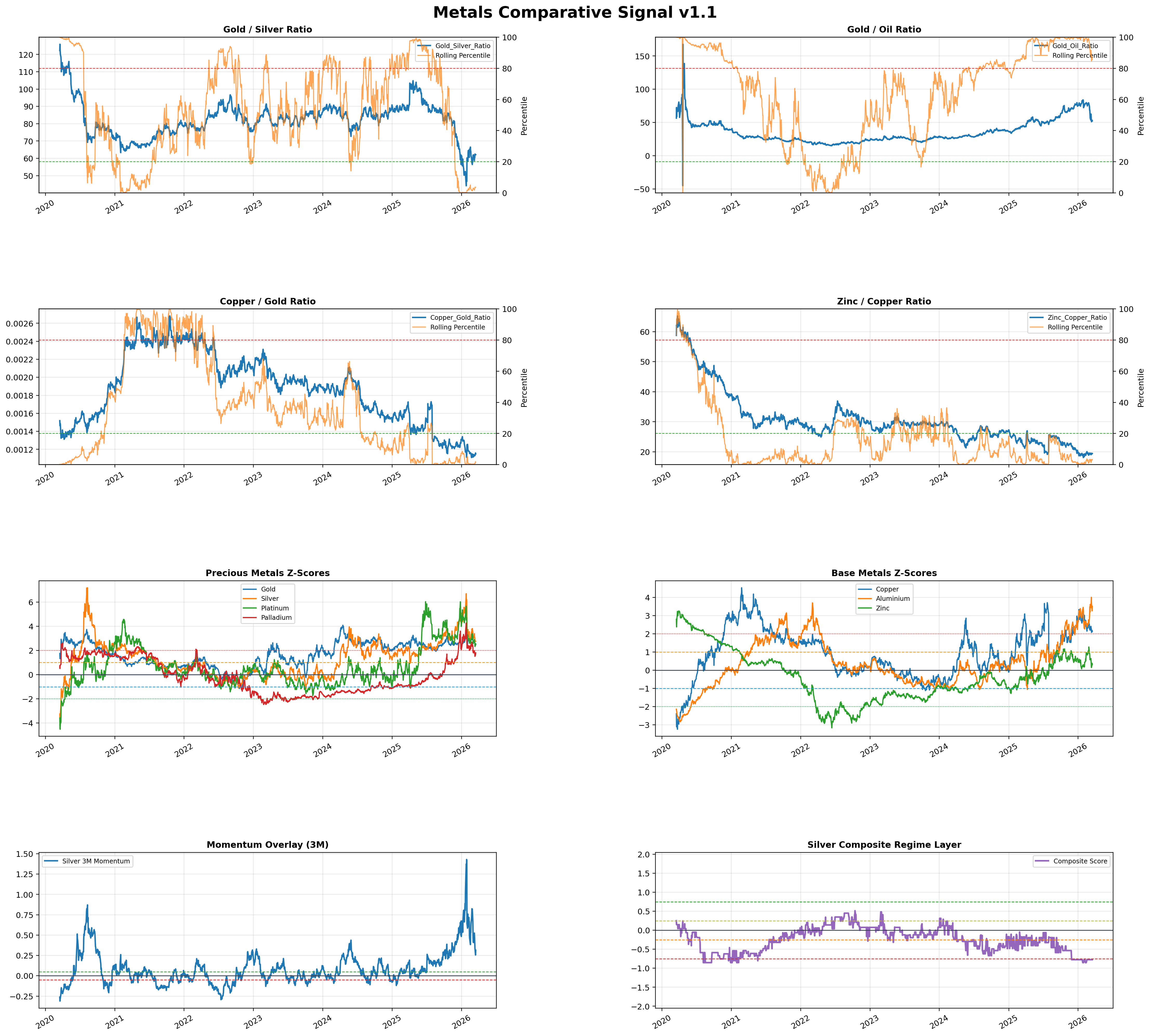
Rolling relative value, regime-aware z-scores, momentum and composite layers, plus silver regime score and z-score percentile context.
Source Data Table▸
The information on this website is provided for general informational and educational purposes only and does not constitute financial, investment, legal, or tax advice. It does not take into account any individual objectives, financial situation, or needs.
All views expressed are personal, based on publicly available information, and do not represent the views of any employer or reflect any proprietary or internal analysis. This information should not be relied upon for making investment decisions.
No representation or warranty is made as to the accuracy, completeness, or timeliness of the information, and no liability is accepted for any loss arising directly or indirectly from its use.
All views expressed are personal, based on publicly available information, and do not represent the views of any employer or reflect any proprietary or internal analysis. This information should not be relied upon for making investment decisions.
No representation or warranty is made as to the accuracy, completeness, or timeliness of the information, and no liability is accepted for any loss arising directly or indirectly from its use.