Labor Market Turnover Signal
Hiring, quits, and separations as a labor market tightness signal.
Gemini Summary
Signal Summary:
- Configuration statement: Given a Quits Rate of 1.9, a Layoff Rate of 1.1, and a Z-score of -0.72, this setup aligns with Downward-biased price paths and Indeterminate volatility, where the dominant risk is Regime shift, not mean reversion (1).
- The signal is currently in a persistent Bearish regime, reflecting a loosening labor market (1).
- Conviction Band: Low; Interpretation Confidence: Low Confidence; Internal Conflict Flag: No. Signal Stability Assessment: Stable; Threshold Proximity: Near; Revision Sensitivity: High.
Methodology Applied:
- A Bearish regime is triggered when the Turnover Differential is below -0.20 or the Robust Z-Score is below -0.50 (1).
- Falling values in the turnover spread imply an economic slowdown and rising recession risk (1).
- Labour Market Turnover Signal: Latest observation dated 2026-04-01 (1).
Key Dynamics:
- The primary driver is the Quits Rate (1.9) failing to offset the Layoff Rate (1.1), maintaining a Z-score of -0.72 (1).
- The signal has remained in the Bearish regime for three consecutive months, suggesting persistent labor market cooling (1).
- Conditional Invalidation: A rise in the Robust Z-Score above -0.50 would shift the signal to Neutral (1).
Scenario Balance:
- Dominant base case: Continued labor market loosening as layoffs remain elevated relative to quits.
- Most plausible upside risk: A sudden rebound in worker confidence leading to a Quits Rate recovery.
- Most plausible downside risk: Acceleration in the Layoff Rate, deepening the Bearish Z-score.
Time Horizon & Aggregation:
- Time Horizon: Cyclical (months) as methodology prioritizes multi-month trends (1).
- Aggregation Weight Hint: Medium as a slow-moving confirmation signal within the labor pillar (1).
Macro Relevance:
- This signal informs the labor demand and worker confidence dimension of the macro environment (1).
- Economic mechanism: Lower quits relative to layoffs suggest reduced labor mobility and weakening employer appetite (1).
- Cycle position: Not determined.
Regime Context:
- The Bearish regime is persistent, having been active for 11 of the last 12 months (1).
- Direction of change: Stabilising within the Bearish range.
Model Limitations:
- Subject to a one-month reporting lag and prone to material annual BLS revisions (1).
Data & References:
Labor Market Turnover Chart
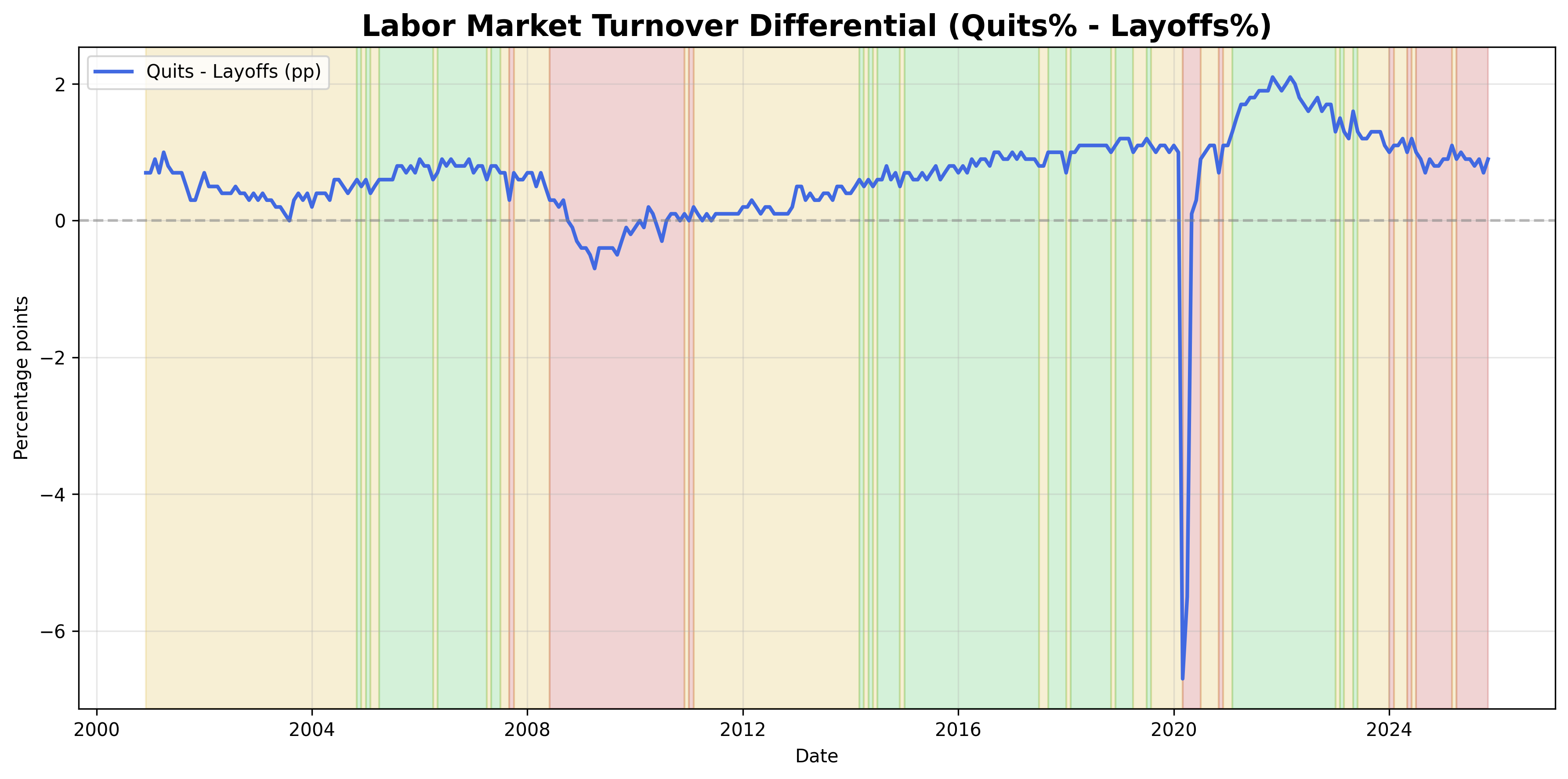
Labor turnover and labor market fluidity.
Labor Turnover Table▸
The information on this website is provided for general informational and educational purposes only and does not constitute financial, investment, legal, or tax advice. It does not take into account any individual objectives, financial situation, or needs.
All views expressed are personal, based on publicly available information, and do not represent the views of any employer or reflect any proprietary or internal analysis. This information should not be relied upon for making investment decisions.
No representation or warranty is made as to the accuracy, completeness, or timeliness of the information, and no liability is accepted for any loss arising directly or indirectly from its use.
All views expressed are personal, based on publicly available information, and do not represent the views of any employer or reflect any proprietary or internal analysis. This information should not be relied upon for making investment decisions.
No representation or warranty is made as to the accuracy, completeness, or timeliness of the information, and no liability is accepted for any loss arising directly or indirectly from its use.