Labor Market Turnover Signal
Hiring, quits, and separations as a labor market tightness signal.
Gemini Summary
Signal Summary:
- Configuration statement (mandatory): Given a turnover differential of 1.0 and a z-score of -0.48, this setup aligns with Indeterminate price paths and Indeterminate volatility, where the dominant risk is Data uncertainty, not Regime shift. (1)
- The signal has entered a Neutral regime as of January 2026, indicating balanced labor flows or a transitional state. (1)
- Conviction Band: Medium; Interpretation Confidence: Mixed Signals; Internal Conflict Flag: No. Signal Stability Assessment: Volatile; Threshold Proximity: Near; Revision Sensitivity: High.
Methodology Applied:
- Regimes are defined by the Turnover_Diff_pp level and Turnover_Diff_z; a z-score between -0.50 and 0.50 signifies a Neutral state. (1)
- Bearish regimes are triggered if the z-score falls below -0.50, implying rising firm retrenchment. (1)
- Labor Market Turnover Signal: latest observation 2026-01-01. (1)
Key Dynamics:
- The primary driver is the stabilization of Quits at 2.0% and Layoffs at 1.0%, resulting in a 1.0pp differential. (1)
- Momentum shows a slight recovery from the Bearish classification in December 2025. (1)
- Conditional Invalidation: A decline in the z-score below -0.50 (currently -0.48) would revert the signal to Bearish. (1)
- History suggests low persistence, with the signal frequently alternating between Bearish and Neutral regimes throughout 2025. (1)
Scenario Balance:
- Base case dominant; risks balanced due to the proximity of the Bearish threshold.
- Upside risk: Strengthening worker confidence if QuitsRate rises above 2.2% while Layoffs remain low.
- Downside risk: Recessionary warning if the LayoffRate increases, pushing the z-score deep into negative territory.
Time Horizon & Aggregation:
- Time Horizon: Cyclical (months); the methodology describes this as a slow-moving confirmation pillar for labor health. (1)
- Aggregation Weight Hint: Medium; relevant for confirming broader business cycle shifts but susceptible to noise.
Macro Relevance:
- Informs the US Labor Market dimension, specifically measuring the net balance of power between employees and employers. (1)
- Economic mechanism: Measures labor market slack and worker confidence; rising values imply expansion, while falling values signal retrenchment. (1)
- Cycle position: Not determined.
Regime Context:
- Newly entered Neutral regime following a single-month Bearish dip; the transition appears to be stabilizing. (1)
- Regime duration: 1 month.
Model Limitations:
- Significant annual revisions and a one-month reporting lag. (1)
- Noisy monthly prints require multi-month moves for high-conviction shifts. (1)
Data & References:
Labor Market Turnover Chart
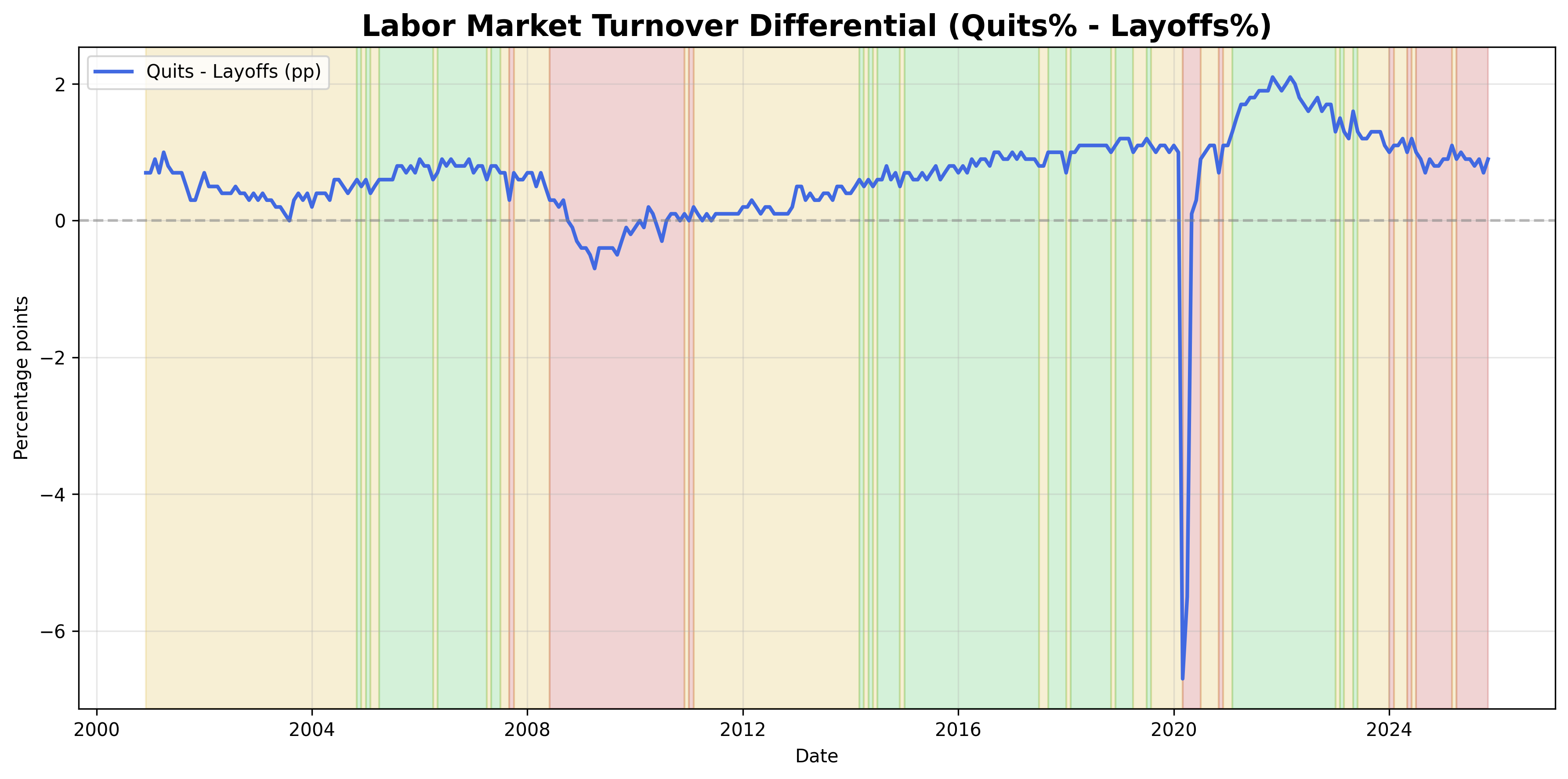
Labor turnover and labor market fluidity.
Labor Turnover Table▸
The information presented is for general informational purposes only and does not constitute financial or investment advice. It has been prepared without regard to individual objectives, financial situation, or needs. You should consider whether it is appropriate for your circumstances and seek independent advice where necessary.