University of Michigan Consumer Sentiment Signal
Consumer confidence and expectations as a forward demand indicator.
Gemini Summary
Signal Summary:
- Configuration statement: Given a Level_z of -0.84, a YoY contraction of -21.3%, and 3M momentum of 5.2%, this setup aligns with Downward-biased price paths and Normal volatility, where the dominant risk is Trend continuation, not Mean reversion (1).
- The signal remains in a Bearish regime, reflecting a persistent demand headwind that has stabilized at depressed levels (1).
- Conviction Band: Medium; Interpretation Confidence: High Confidence; Internal Conflict Flag: No. Signal Stability Assessment: Stable; Threshold Proximity: Near; Revision Sensitivity: Moderate.
Methodology Applied:
- Regime classification: Bearish requires Level_z < -0.75 combined with negative YoY or 3M momentum (1).
- Smoothing: Level metrics are derived from a 3-month moving average to reduce survey noise (1).
- Standardization: Level_z uses a 120-month rolling blend of mean/standard-deviation and median/MAD anchors (1).
- Data: University of Michigan: Consumer Sentiment (UMCSENT); latest observation: 2026-01-31 (1).
Key Dynamics:
- The dominant driver is the Level_z of -0.84, which sits below the -0.75 bearish threshold despite recent 3M stabilization (1).
- Divergence exists between long-term negative YoY momentum (-21.3%) and positive 3M momentum (5.2%), suggesting emerging transition risk (1).
- Conditional Invalidation: Level_z rising above -0.25 would transition the signal to Neutral (1).
- The signal has shown high directional consistency, remaining Bearish for thirteen consecutive months (1).
Scenario Balance:
- Base case dominant: Persistent bearish sentiment continues to weigh on household consumption demand.
- Upside risk: Sustained positive 3M momentum triggers a breakout from the bearish zone.
- Downside risk: Sharp reversal in monthly sentiment prints validates the long-term YoY downward trend.
Time Horizon & Aggregation:
- Time Horizon: Cyclical (months); consumer sentiment traditionally leads household spending growth (1).
- Aggregation Weight Hint: Medium; survey-based signals require validation from "hard" activity data before extreme weighting.
Macro Relevance:
- Informs aggregate demand and pricing power dimensions within the macro framework.
- Economic mechanism: Sentiment captures incremental information regarding future household spending and economic confidence (1).
- Cycle position: Not determined.
- Interacts with labor market and inflation signals to gauge the durability of consumer-led expansion.
Regime Context:
- Persistent Bearish regime entered in January 2025 and sustained through January 2026 (1).
- Direction of change: Stabilising at historically low standardized levels (1).
Model Limitations:
- High survey volatility can lead to noise-driven flips if thresholds are too narrow (1).
- Sentiment can be influenced by non-economic factors, potentially decoupling from hard spending data (1).
Data & References:
- UMCSENT: University of Michigan Consumer Sentiment, observed 2026-01-31 (1).
- Influential data: Level_z (-0.84) and YoY % Change (-21.3%).
- Additional data such as PCE Real Spending and Jobless Claims would improve reliability.
Consumer Sentiment Chart
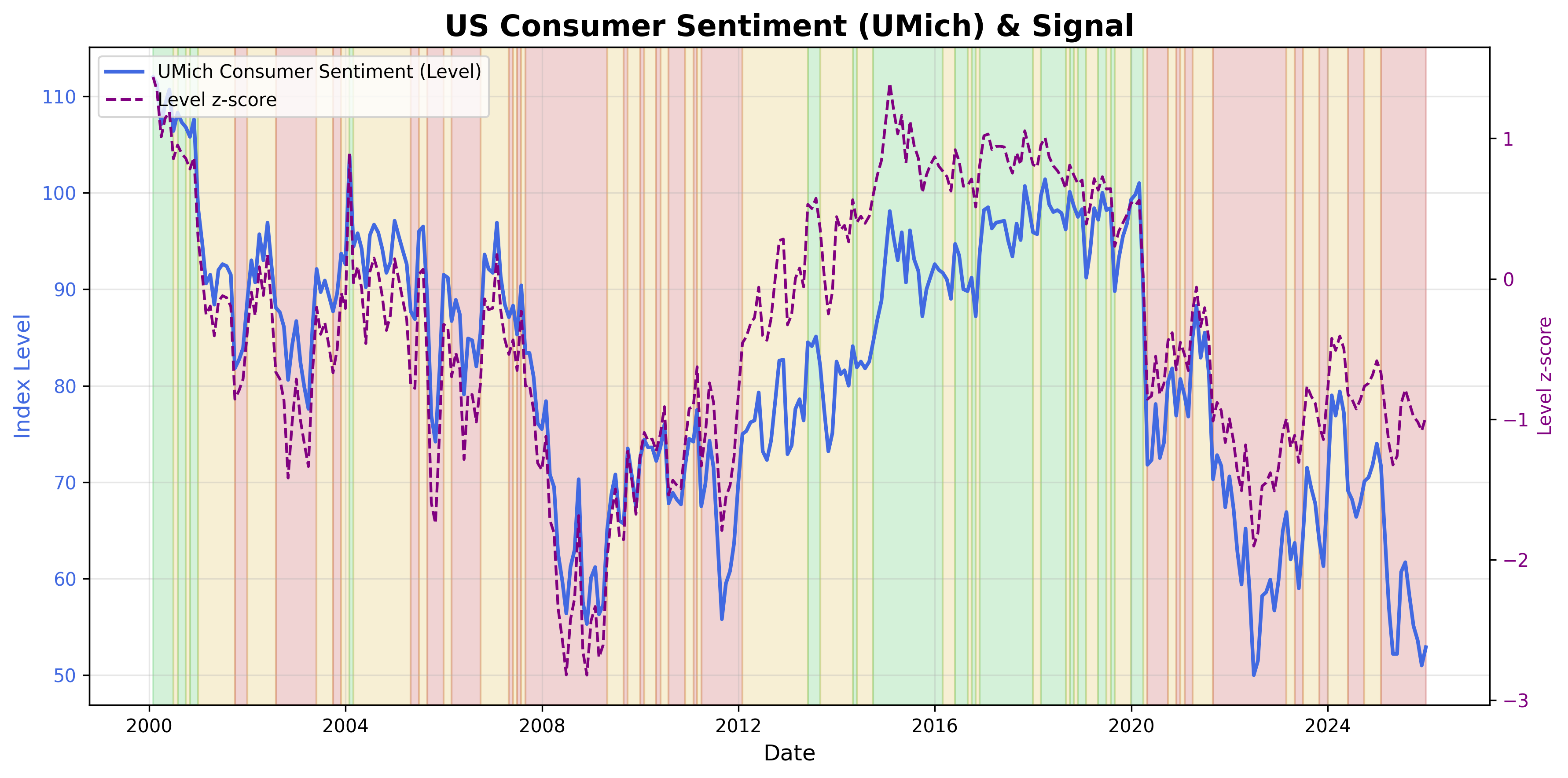
University of Michigan Consumer Sentiment Index.
Consumer Sentiment Table▸
The information presented is for general informational purposes only and does not constitute financial or investment advice. It has been prepared without regard to individual objectives, financial situation, or needs. You should consider whether it is appropriate for your circumstances and seek independent advice where necessary.