Capex Intent Signal
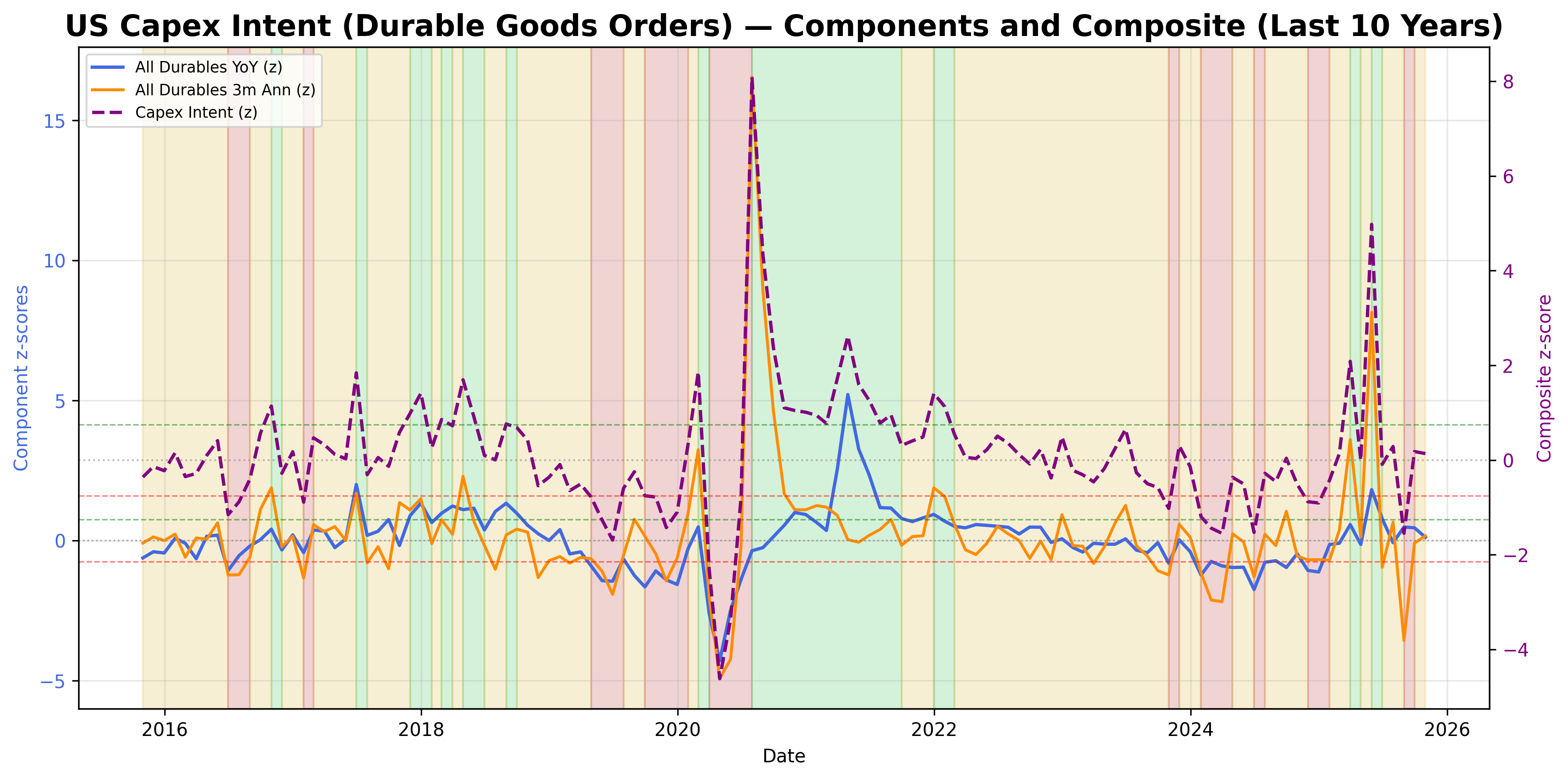
Capex intent from durable goods order momentum.
Gemini Summary
Signal Summary:
- Configuration statement: Given a Capex_Intent reading of 2.04 and aligned positive Z-scores for both headline and ex-transport orders, this setup aligns with Upward-biased price paths and Normal volatility, where the dominant risk is Trend continuation, not mean reversion (1).
- The signal is currently in a robust Expansion regime, which has persisted for six months and is rapidly strengthening.
- Conviction Band: Extreme; Interpretation Confidence: High Confidence; Internal Conflict Flag: No. Signal Stability Assessment: Improving; Threshold Proximity: Far; Revision Sensitivity: Unknown.
Methodology Applied:
- Expansion Phase: Defined as Capex_Intent > 0.75, indicating unusually strong durable orders momentum and a rising pipeline for equipment spending (1).
- Composition Check: Methodology prioritizes ADXTNO (Ex-Transport) to identify broad-based demand and avoid aircraft-driven distortions (1).
- Inflection Detection: Compares 3-month annualized growth against Year-over-Year (YoY) rates to identify early cyclical shifts (1).
- Latest dataset observation: 2026-04-30 (1).
Key Dynamics:
- The primary driver is the surge in ADXTNO momentum, with its 3-month annualized Z-score reaching 2.17, confirming high-intensity business demand (1).
- Momentum is currently accelerating; the Capex_Intent value has risen from 0.79 to 2.04 since November 2025.
- Internal coherence is high, as headline DGORDER (17.3% YoY) and ex-transport orders (9.1% YoY) are both trending higher in tandem (1).
- Conditional Invalidation: The interpretation would reverse if Capex_Intent falls below the 0.75 expansion threshold.
- Signal stability is high, characterized by five consecutive months of rising intent values.
Scenario Balance:
- Base Case dominant: Continued industrial expansion supported by accelerating durable goods demand and positive investment momentum.
- Upside risk: A supply-side capacity squeeze if real volume demand outpaces current industrial production capacity.
- Downside risk: Nominal price inflation masking a secret decline in real order volumes, as noted in methodology limitations (1).
Time Horizon & Aggregation:
- Time Horizon: Cyclical (months); the signal typically leads capital expenditure cycles and cyclical earnings sensitivity.
- Aggregation Weight Hint: High; the current reading is at a multi-year extreme, providing a clear directional impulse for macro aggregation.
Macro Relevance:
- Informs the demand impulse dimension, specifically regarding capital expenditure and industrial equipment demand.
- Economic mechanism: Rising business demand for long-lasting goods signals a transition to a high-growth phase and increased risk-on sentiment (1).
- Cycle position: Not determined (mapping not provided in methodology).
- Interaction: This signal typically confirms trends in PMI New Orders and Industrial Production.
Regime Context:
- The signal transitioned from Neutral to Expansion in November 2025 and has remained persistent for six months.
- The regime is currently strengthening, moving deeper into the expansionary zone.
Model Limitations:
- The signal is subject to high monthly volatility and significant data revisions (1).
- Nominal price effects may mask real volume dynamics during periods of high inflation (1).
Data & References:
- Latest data point: 2026-04-30; Capex_Intent 2.036 (1).
- Most influential: ADXTNO_3mAnn and Z_EX_YoY scores.
- Public datasets for improvement: U.S. Industrial Production, ISM Manufacturing PMI.
Capex Intent Chart
Durable goods orders as a proxy for business investment intent.
Capex Intent Table▸
The information on this website is provided for general informational and educational purposes only and does not constitute financial, investment, legal, or tax advice. It does not take into account any individual objectives, financial situation, or needs.
All views expressed are personal, based on publicly available information, and do not represent the views of any employer or reflect any proprietary or internal analysis. This information should not be relied upon for making investment decisions.
No representation or warranty is made as to the accuracy, completeness, or timeliness of the information, and no liability is accepted for any loss arising directly or indirectly from its use.
All views expressed are personal, based on publicly available information, and do not represent the views of any employer or reflect any proprietary or internal analysis. This information should not be relied upon for making investment decisions.
No representation or warranty is made as to the accuracy, completeness, or timeliness of the information, and no liability is accepted for any loss arising directly or indirectly from its use.