Investor Anatomy Series
Institutional macro signal interpretation for squeeze_exhaustion_risk_indicators.
The Squeeze and Exhaustion Risk Indicators have transitioned back to a Normal regime as trend fatigue across the futures complex stabilizes, reducing immediate tactical fragility.
What this signal measures
This signal captures the aggregate breadth of markets experiencing either forced liquidation risk, known as a squeeze, or momentum decay, referred to as exhaustion. We use this to identify the real-world mechanism where market participants are forced to exit positions due to price shocks or where a prevailing trend simply runs out of new buyers or sellers. It provides a macro view of how brittle or overextended price action has become across hundreds of individual markets.
Why it matters
Professional investors monitor these metrics to identify potential turning points and non-fundamental volatility. High readings indicate a transition toward late-cycle behavior where markets become vulnerable to sharp reversals that are driven by positioning flows rather than economic shifts. By tracking these transmission channels, we can better assess when to tighten risk controls or anticipate shifts in broader market liquidity and risk appetite.
What the latest reading tells us
As of the seventeenth of March, the signal indicates that tactical risks have moderated back to historical medians. We observe the exhaustion component has retreated to zero point four nine, falling just below the threshold for moderate risk. Simultaneously, the squeeze component remains subdued at negative zero point eight six. This suggests that the widespread trend fatigue observed earlier in the month has eased, and the immediate threat of forced covering or liquidations has diminished.
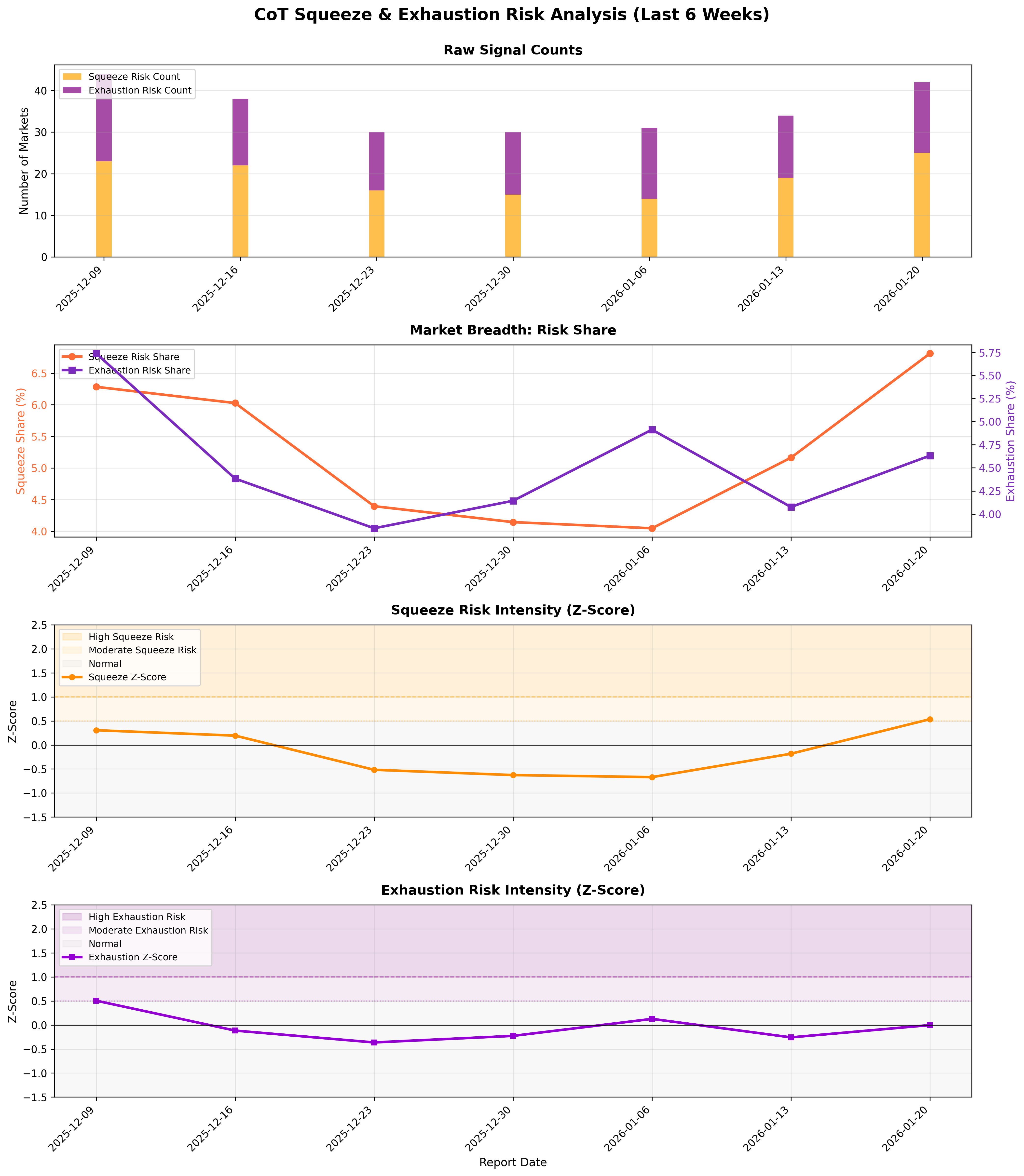
We interpret this current reading as a period of stabilisation. The return to a normal regime implies that prevailing market trends are currently less likely to face structural failure from positioning extremes. This represents a transition away from the tactical fragility seen in early March, and we will monitor the exhaustion breadth for any renewed move toward the zero point five threshold as the next sign of potential trend maturity.