Investor Anatomy Series
Institutional macro signal interpretation for cpi_vs_ppi_divergence_signal.
The divergence between producer and consumer price growth has transitioned toward a slight positive spread but remains within historical noise thresholds, indicating a stable pricing relationship.
What this signal measures
We monitor the gap between pipeline inflation at the production level and the final prices paid by consumers. This signal captures the relative speed of price changes as they move through the supply chain, reflecting the balance between upstream cost pressures and downstream retail pricing power.
Why it matters
Professional investors track this relationship to identify early signs of margin compression or future shifts in consumer inflation. When producer prices significantly outpace retail prices, it often signals cost-push pressures that can lead to delayed disinflation or reduced corporate profitability. Conversely, a significant drop in producer prices relative to consumer prices typically suggests a cooling inflation environment.
What the latest reading tells us
Based on data from the twenty eighth of February, we observe a divergence score of zero point two three. According to our methodology, this value places the signal in a neutral regime because the divergence is currently within historical noise thresholds. While producer prices are growing at three point two two percent compared to two point four three percent for consumers, the relationship remains stable and does not imply significant upstream cost-push pressure.
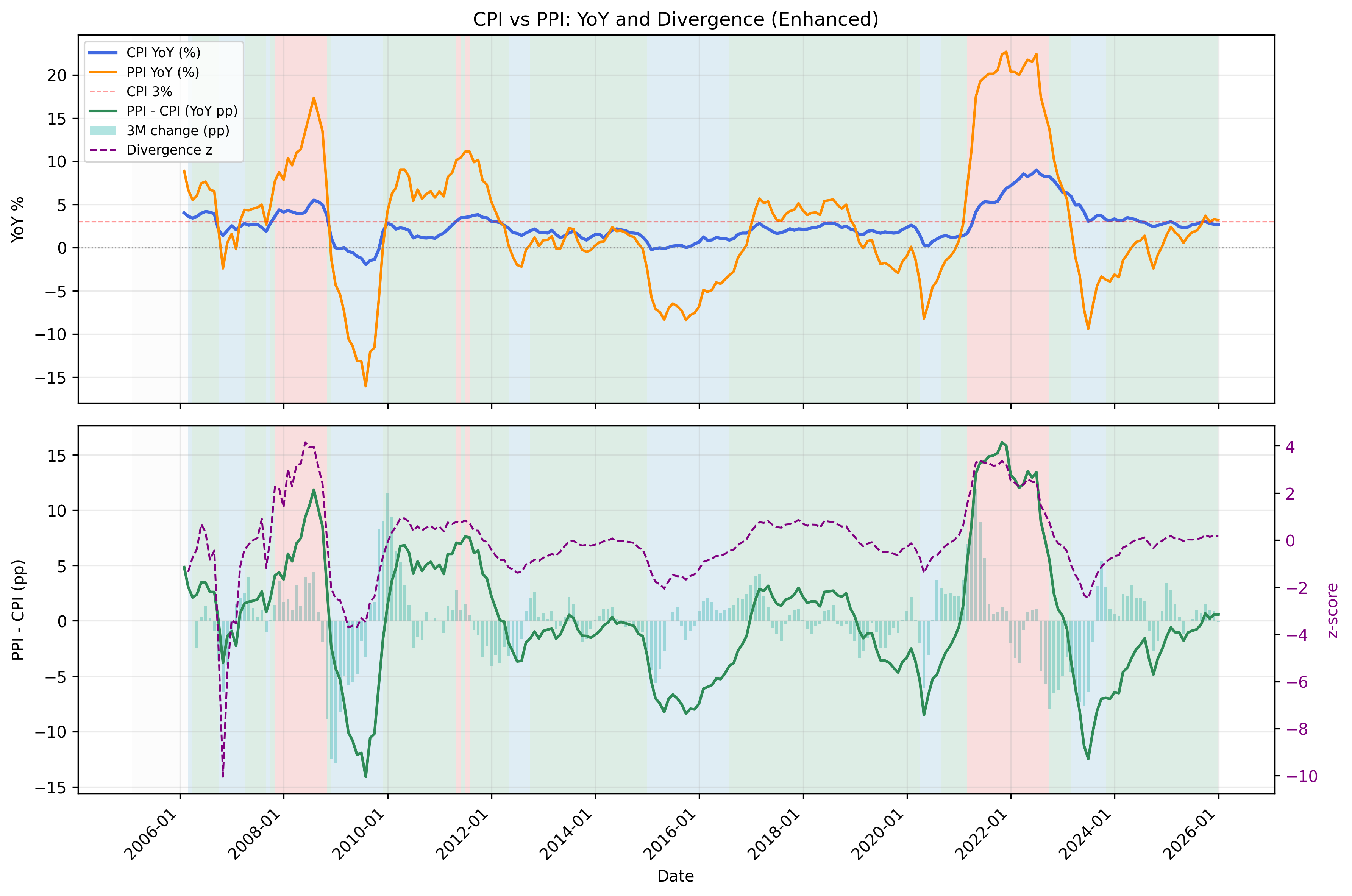
We interpret this latest reading as a period of stabilization where the producer-to-consumer price gap is not yet signaling a transition in the inflation cycle. The signal represents a confirmation of current price stability, and we will monitor for any move in the divergence score beyond the zero point three five threshold as a sign of emerging pipeline pressure.