Weekly Hours Signal
Weekly hours signal: tracking average working hours as an indicator of labour demand.
Gemini Summary
Signal Summary:
- Configuration statement: Given a neutral composite z-score of -0.67 and a significant manufacturing hours z-score of -1.35, this setup aligns with range-biased price paths and compressed volatility, where the dominant risk is a regime shift toward COOL, not a return to HOT conditions (1).
- The signal is currently classified as NEUTRAL, reflecting stable but historically low utilization in the manufacturing sector (1).
- Conviction Band: Medium; Interpretation Confidence: High Confidence; Internal Conflict Flag: No.
Methodology Applied:
- Regimes are defined by the Hours_Level_Composite_z: HOT (> +0.75), COOL (< -0.75), and NEUTRAL otherwise (1).
- The signal averages robust z-scores from total private and manufacturing sectors to gauge broad labor demand (1).
- Latest observation: 2025-12-01.
Key Dynamics:
- The primary driver is the manufacturing hours z-score (-1.35), which is deeply in restrictive territory, offset by a stable total private z-score (0.00) (1).
- Momentum has stabilized, with the 3-month composite change reaching 0.00 after a period of volatility (1).
- Internal tension exists between the resilience in broad private hours and the contractionary signals in industrial production proxies (1).
- Conditional Invalidation: An unsmoothed composite z-score falling below -0.75.
Scenario Balance:
- Base case dominant: Labor demand remains in a stagnant "neutral" state as manufacturing drags on the aggregate.
- Most plausible upside risk: A sudden expansion in manufacturing workweeks driven by industrial re-stocking.
- Most plausible downside risk: Total private hours follow the manufacturing lead, pushing the composite into the COOL regime.
Time Horizon & Aggregation:
- Tactical (weeks): Weekly hours are highly sensitive to immediate production shifts and demand shocks (1).
- Aggregation Weight Hint: Medium; this signal provides a critical real-time check on payroll growth expectations.
Macro Relevance:
- Informs the "demand" dimension, specifically the intensity of labor utilization before headcount changes occur.
- Suggests a late-cycle position where hours are cut before significant layoffs begin.
- Typically acts as a lead indicator for payroll growth and consumer sentiment signals.
Data & References:
- Primary dataset: BLS Current Employment Statistics (CES) Weekly Hours (2025-12-01).
- Influential datapoints: manufacturing_hours (40.0) and mfg_hours_z (-1.35).
- Additional reliability could be improved by integrating the ISM Manufacturing Employment Index.
Weekly Hours Signal Chart
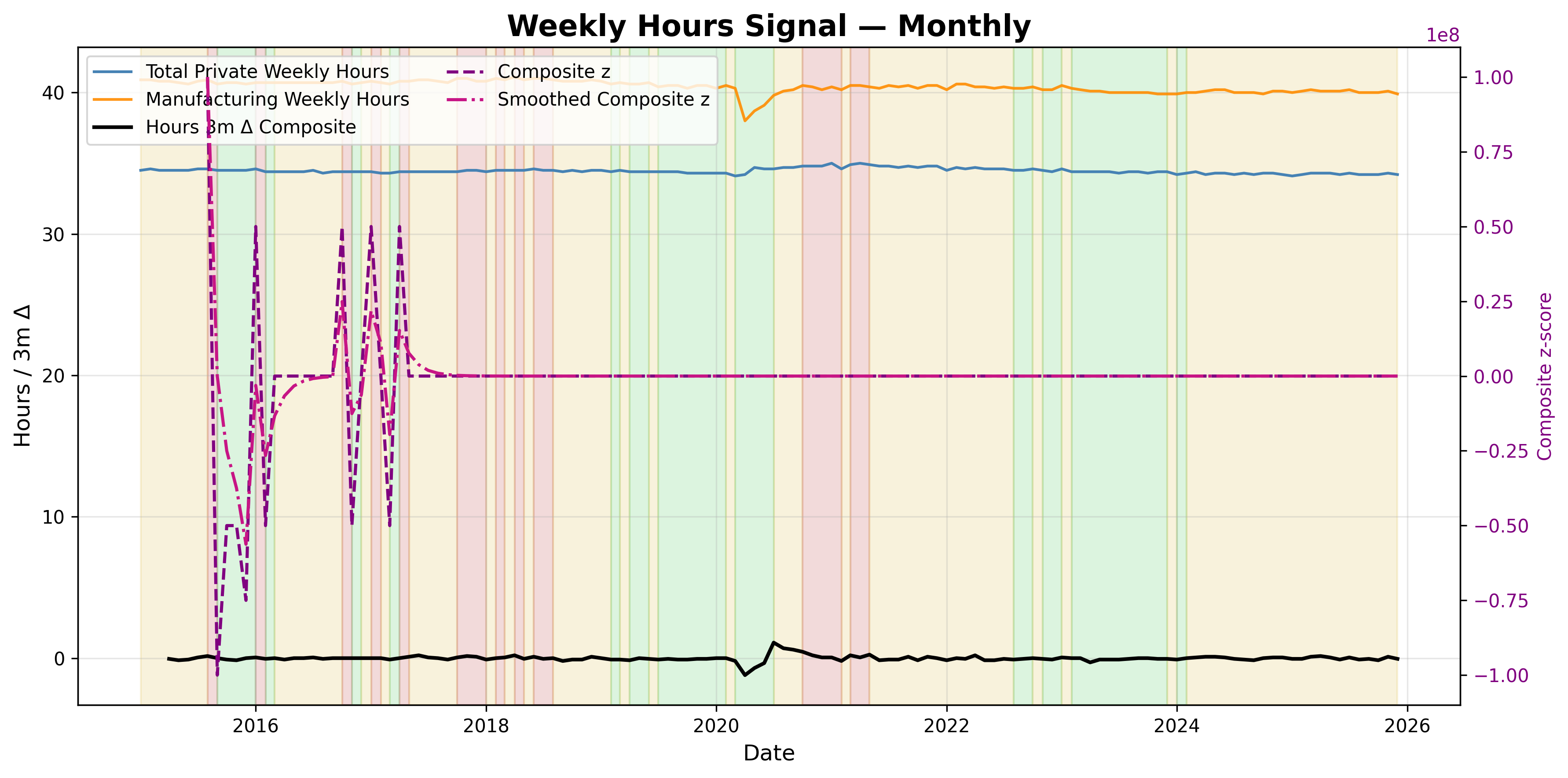
Weekly hours: average working hours as a labour demand indicator.
Weekly Hours Signal Table▸
The information presented is for general informational purposes only and does not constitute financial or investment advice. It has been prepared without regard to individual objectives, financial situation, or needs. You should consider whether it is appropriate for your circumstances and seek independent advice where necessary.