Lithium Price Research
Institution-level institutional lithium target extraction from IA researcher PDFs, with historical target tracking and synthesis.
Market Interpretation
Current Median Target
20,600.00
Recent (latest 90 days)
Current Target Range
20,000.00 - 21,600.00
Focus window min/max
Recent Forecast Count
3
Numeric rows driving current view
Median Shift vs Prior
↑ +7800.00
Prior median: 12,800.00
Latest Publication
2026-04-03
Based on publication dates in the latest 90 days.
Comparability
Low
Limited recent sample size.
Current View: The institutional outlook for lithium has undergone a significant upward shift, with recent market-implied targets and forecasts now clustering around the $20,000 to $21,600 per tonne range. This represents a substantial strengthening compared to the late-2025 consensus, which saw price targets frequently positioned between $10,000 and $13,000. Recent data from April 2026, primarily driven by futures curves on the CME and LME, indicates a tighter and more optimistic consensus for the remainder of 2026 and early 2027.
Recent Predictions: The most recent evidence, dated April 2026, comes from exchange-cleared futures which price lithium between $20,000 and $21,600. These figures are supported by earlier Q1 2026 survey averages and range midpoints from Reuters and A&S Power, which also centered near the $20,000 mark. This recent cluster suggests that market participants are increasingly pricing in a tighter supply-demand balance than was anticipated six months ago.
Historical Context: Looking back at late 2025, the target distribution was considerably softer. JP Morgan and the Australian Department of Industry provided point forecasts of $12,300 and $10,250 respectively, citing modest demand and supply response lags. The shift from these levels to the current $20,000+ environment highlights a significant change in market sentiment, likely fueled by accelerating demand for energy storage systems (ESS) and potential delays in new supply projects.
Institutional Dispersion: While the median has shifted upward, the outlook remains highly dispersed and characterized by low conviction among major banks. Goldman Sachs remains a notable bearish outlier with a 2026 forecast of $8,900, arguing that a looming "wave of new supply" will eventually overwhelm demand. Conversely, UBS maintains a more bullish stance at $26,000, pointing toward spodumene conversion constraints and electric vehicle demand uplift.
Comparability and Data Limits: Comparability between these data points is weakened by the mix of methodologies. Recent high-conviction figures are market-implied futures prices, which reflect real-time hedging and sentiment, whereas the lower historical targets are fundamental research models. Furthermore, several major research houses, including Benchmark Mineral Intelligence and Wood Mackenzie, provide qualitative commentary or paywalled data without public numeric targets, limiting the total pool of comparable point forecasts.
Overall Bias: The current data distribution implies a clear upside bias relative to historical projections, but with significant underlying uncertainty. The gap between the most conservative bank forecast ($8,900) and the most optimistic base case ($26,000) suggests that while the "market price" has stabilized near $20,000, institutional analysts remain divided on whether this level is sustainable or merely a temporary peak before new capacity arrives.
Target Visuals
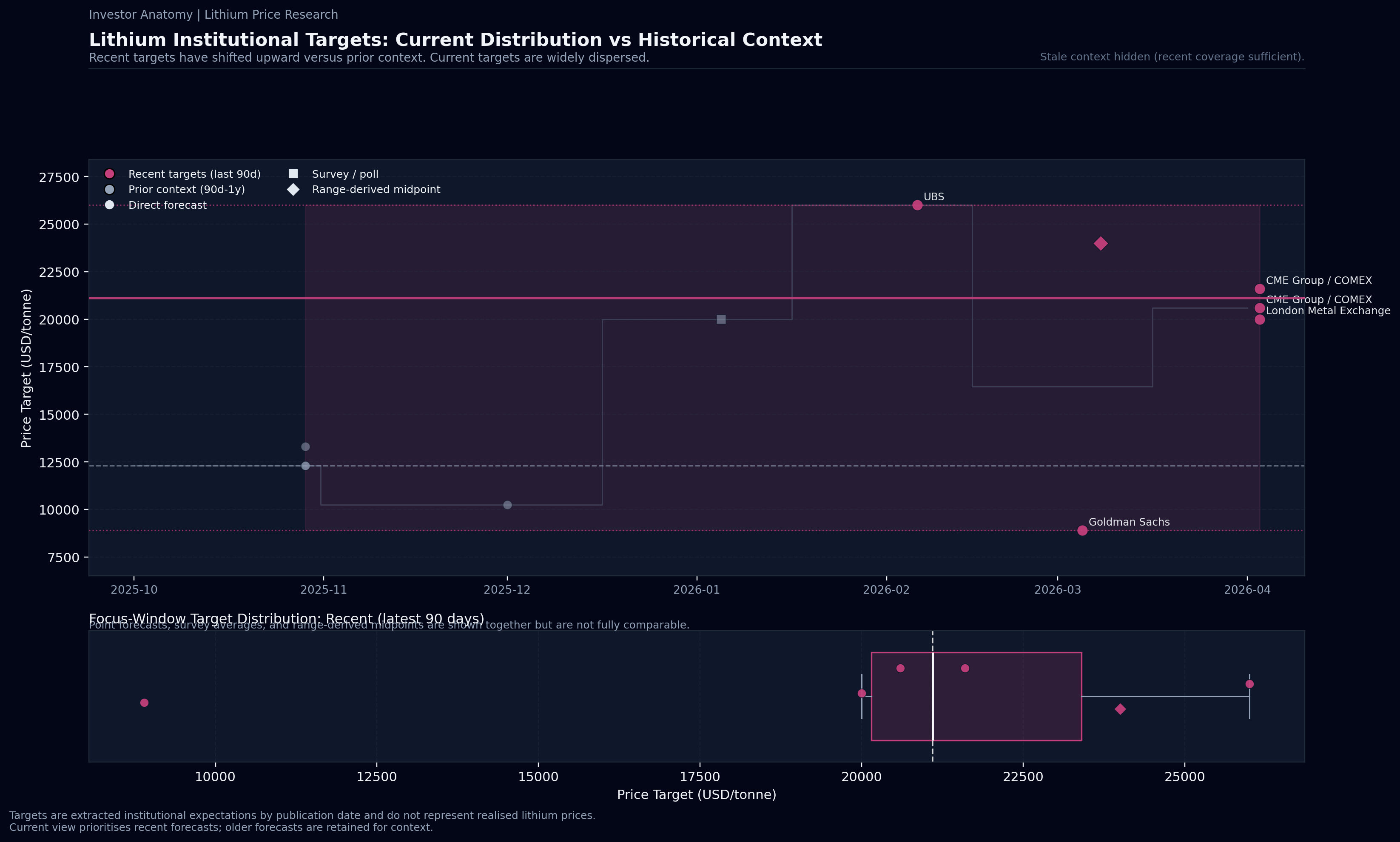
Recent forecasts are emphasised; older retained forecasts provide historical context. Targets represent extracted institutional expectations, not realised lithium prices.
Extracted Data (Validation)▸
All views expressed are personal, based on publicly available information, and do not represent the views of any employer or reflect any proprietary or internal analysis. This information should not be relied upon for making investment decisions.
No representation or warranty is made as to the accuracy, completeness, or timeliness of the information, and no liability is accepted for any loss arising directly or indirectly from its use.